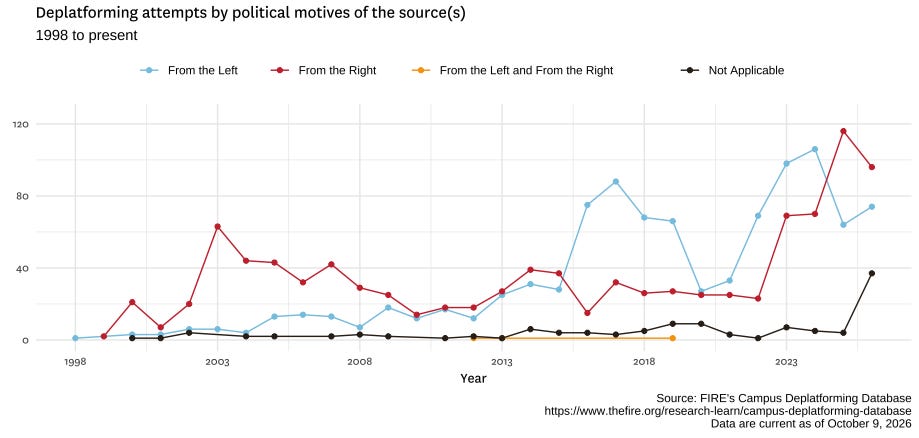
… and argue Murray and Shaw’s article doesn’t hold up without its idiosyncratic definition of sex. I’ll also highlight where I share their concerns. In an upcoming post I’ll write about legal academia more broadly and its failure to debate (and therefore understand) transgender legal issues.
Who’s Who
SCR is among the most prestigious law journals in America. Its publisher brags that it is the top constitutional law journal. Unlike most of its peers, which are edited by law students, SCR is run by distinguished faculty. Baude, the SCR editor who is listed as its contact, teaches at the University of Chicago Law School. He clerked for Chief Justice John Roberts.
On October 22, Rajiv Batra came back to the department he graduated from in 1983 and spent an hour on the half of a startup nobody puts in the pitch deck. Not the idea, not the funding. The organization you have to build around them.
Batra co-founded Palo Alto Networks in 2005 with Nir Zuk, after founding VitalSigns Software and serving as the first employee at Peribit Networks, which Juniper bought. He has watched three companies from the inside, and what he told a room of computer sciences students was mostly about people.
Hire the very best for the first fifty seats and do not compromise. Thirty engineers who are genuinely the best, he said, will out-build two hundred ordinary ones. Build the culture in the first year, because you cannot install it in the third. Give equity widely, so more than five people feel they own the thing: fewer people means everybody gets richer. Do not micromanage, or your life as a founder will be miserable and the company will still fail. And when someone is not working out, deal with it, because most leaders avoid that call and the damage spreads.
He was blunt about quitting, too. Set goals a couple of years out. Miss them both and walk away rather than run what he calls a living dead company, the kind that saps your energy for a decade without ever arriving.
The questions were good ones. Can you build a company outside a tech hub? His answer was honest rather than encouraging. What about AI — does it end the software startup? He thinks not, and he thinks the people in that room are the ones who will sit between humans and the machines. And how do you pick a co-founder? He described fifteen minutes with Nir Zuk, before there was a company, that told him everything he needed to know.
His line about rules sums up the hour: “there’s no rule. You are it.”
This has been a longstanding grievance of mine, and not just against The Times, against all the major media outlets. I’ll frequently talk to a reporter and they’ll say something like, “How would you identify yourself?” And they’re not asking for my pronouns. They’re trying to get at my politics. And sometimes I’m of course like, you know, “I’m a law professor.” And they say, “Well, how do you characterize yourself?” It’s like, “Well, I’m a constitutional law professor,” and I know what they’re getting at. Eventually I just say, fine, if you want to call me conservative, you can.
And I suspect the reason why they do this is to give their readers sort of a grounding of where I’m coming from. And if this was sort of a neutral policy that’s applied across the board, I wouldn’t have much ground to object, but I find that it’s not.
Back in February of this year, I was quoted twice in The New York Times back to back in the span of 24 hours, which is, you know, pretty cool. But I sort of noticed that both of the references were to Josh Blackman as a “conservative” law professor. And I just thought that was strange. So I went through the Westlaw archives and just sort of searched for “liberal” law professors and “conservative” law professors in the New York Times database, and it was far more likely that you’re identifying a conservative than a liberal. And those numbers are stacked because liberals are quoted even more often. So the numbers even have a greater disparity.
Sound Off: A Double Standard for ‘Conservative’ and ‘Liberal’ Labels?
Related: Do you Trust the News? A New York Times event at the University of Wisconsin-Madison.
According to a recent Gallup poll, roughly 88% of parents believe their child is performing at or above grade level in reading and math. Yet the reality is quite the opposite: the National Assessment of Educational Progress found that only 31% of fourth graders are proficient readers.
We have an honesty gap in American education.
The gap is not simply between perception and reality. It is the gap between what students and families are told about progress and what academic outcomes ultimately reveal. Families cannot address challenges they do not fully understand, and schools cannot solve problems they are unwilling to name.
It’s also a gap between what school districts are paying for and what they’re getting in return. Every fall, districts invest millions of dollars in programs designed to improve student achievement. They invest heavily in educational resources which often start with the best intentions: adopting new curricula, purchasing technology, hiring tutoring providers and launching new interventions.
That challenge is particularly important given the scale of educational spending. More broadly, contracted educational services account for approximately 11% of school expenditures, or roughly $100 billion annually. National assessments show that reading and math achievement remain below pre-pandemic levels, with proficiency rates still lagging where they stood just a few years ago.
We can readily track how much money is spent, but we are often far less transparent about whether those investments are improving student learning.
And that’s particularly troubling because there is no more important investment we make as a society than the investment we make in our children. Taxpayers devote hundreds of billions of dollars to public education every year. Every education dollar represents an investment in our future workforce, our communities, and the next generation of leaders. That’s why we are right to expect evidence that those investments are producing meaningful results for students.
——-
“They were relieved that American classes are so much easier than those in Taiwan”
Madison’s district, despite an elite university pipeline, hypereducated leadership, and a shiny, new strategic plan, suffers the same frailties as Milwaukee’s: basement performance, backbreaking spending. But while Milwaukee is pulling out of its tailspin due to courageouschoices from the top, Madison is ponderously ambling to nowhere. Just ask the locals. “You need the marketing, and you need the product,” as a parent told a reporter. “I’m missing the product.”
2025-2026 Madison 4k-3rd grade Early Literacy Screener report: The bar moves faster than the kids.
2026-2027 Madison K-12 $pending continues to grow, fueled by a 9.7% (!) property tax increase. Total spending will be at least $706,000,000 for 25,003 students, or $28,236 per student.
May 2026 Madison School District Presentation: 7,095 adults for 25,003 students (3.52 students per adult!)
Pressure has intensified on Los Angeles Unified to follow through with emergency budget cuts after a California fiscal crisis oversight team concluded that the school district is at “high risk” for insolvency — and must move quickly to avoid losing control over budget decisions.
The state’s school Fiscal Crisis and Management Assistance Team has concluded that the poor financial outlook has been brought on by increased hiring as enrollment declined, employee raises that exceeded the rate of increased state funding, sharply higher costs for educating students with disabilities, and maintaining classroom space for twice as many students as needed.
“The district has not fully addressed deficiencies” identified by the Los Angeles County Office of Education in its fiscal oversight letters, the team stated in a reportpresented to the school board Tuesday. “The district has not sufficiently adjusted staffing and facilities use in response to declining enrollment.”
The financial troubles are especially concerning because the Los Angeles Unified School District has failed to meet past budget reduction targets, the report concluded, and the stakes have become higher, with solutions more painful to carry out. The projected cutbacks over the next three years include more than 6,000 jobs in a school system that has been adding employees. The current workforce is about 80,000 full- and part-time employees.
District officials are not challenging the data.
“Los Angeles Unified has been transparent about significant financial challenges,” a district statement said. “The Board has already adopted a fiscal stabilization plan to address these challenges, including making difficult decisions to maintain the District’s financial health.”
After the presentation, Supt. Andrés E. Chait spoke of the importance of “fidelity” to the district’s “fiscal stabilization plan” and “certainly being nimble as conditions change, but for the most part adhering to what was put forth back in June.”
This is the final form of a project that started a hundred years ago to spread free markets and create global peace and instill self-governance throughout the world.
This is your legacy, Alex Soros.
Your father spent his life fighting Communism. You, as his protege, will spend your life perfecting Communism.
These developments are downstream of both specific political decisions by the British elite and the subsequent destruction of British standing and soft power.
Britain operates a very tight information environment for its media, hence public knowledge of this – Britain’s most important ally saying the dissolution of Britain is inevitable – has been minimal. Its momentousness, however, is reflected elsewhere: discussion has been widespread globally and on alternative, less controlled, media sources such as X, formerly Twitter.
Trump’s motivations are easy to explain and derive from continued British attempts to impede his presidency and insult his person: the laughably amateurish Steele dossier and the attempt at electoral interference by the Labour Party in favor of Kamala Harris. The motivation and causes on the American side are clear; less clear are the collapse in British soft power and the motivations of the Irish side in this announcement.
This decline is global, but this article will focus on the hostility created by British actions in the US and Ireland.
“Now I’m stuck in seventh-grade math, and it’s so boring,” said Aditya, who the Chronicle is identifying by first name only because he’s a minor. “I strongly dislike the system.”
His concerns echo those of one side of a divisive debate raging in the Palo Alto Unified School District over mathematics education, which has culminated in a contentious school board race for two termed-out seats.
While next five-person board will have to address a substantial budget deficit, mathematics has become a defining issue for at least two candidates, one of whom sued the district after his son was prevented from taking a more advanced course the lawsuit argued he was qualified for.
The debates have centered on three main issues: whether the district is making it too difficult to skip a grade in math, if the district should track kids into separate math classes based on performance, and whether it should offer advanced classes beyond AP Calculus.
At the core of the current debate is whether a new math framework that Palo Alto implemented in 2020 is working, part of a wider dispute in many Bay Area districts over how to balance equity and excellence. The University of California came under increasing national scrutiny over whether to bring back SAT and ACT scoresin admissions after a report about UC studentsstruggling with basic math.
Palo Alto eliminated middle school math tracking in 2020 with the purpose of ensuring all students would take algebra by eighth grade, which research has showncan improve math achievement. To do so, it compressed four years of math into three. It got rid of accelerated math courses in middle school, though students are permitted to skip a grade of math if they pass an annual test in middle school, a hurdle that’s sparked pushback.
For fiscal 2025, the system recorded $59 million in operating income, equal to a margin of 0.3%, according to the Globe. Its total margin, which included investment income, was $2.38 billion.
June 2008, candidate Obama: “we’ll lower premiums by up to $2,500 for a typical family per year.”
That year KFF (Kaiser Family Foundation) put the average family premium at $12,680. KFF’s 2026 number just dropped: $28,303. Workers alone now pay $7,471, up 9% in a single year, while wages rose 3.7%.
Then 2013 brought the sequel: “For a lot of people, it will be cheaper than your cell phone bill.”
Show me the phone plan that runs $2,358 a month. Nine days before the midterms, the party that built this machine is asking for your vote again.
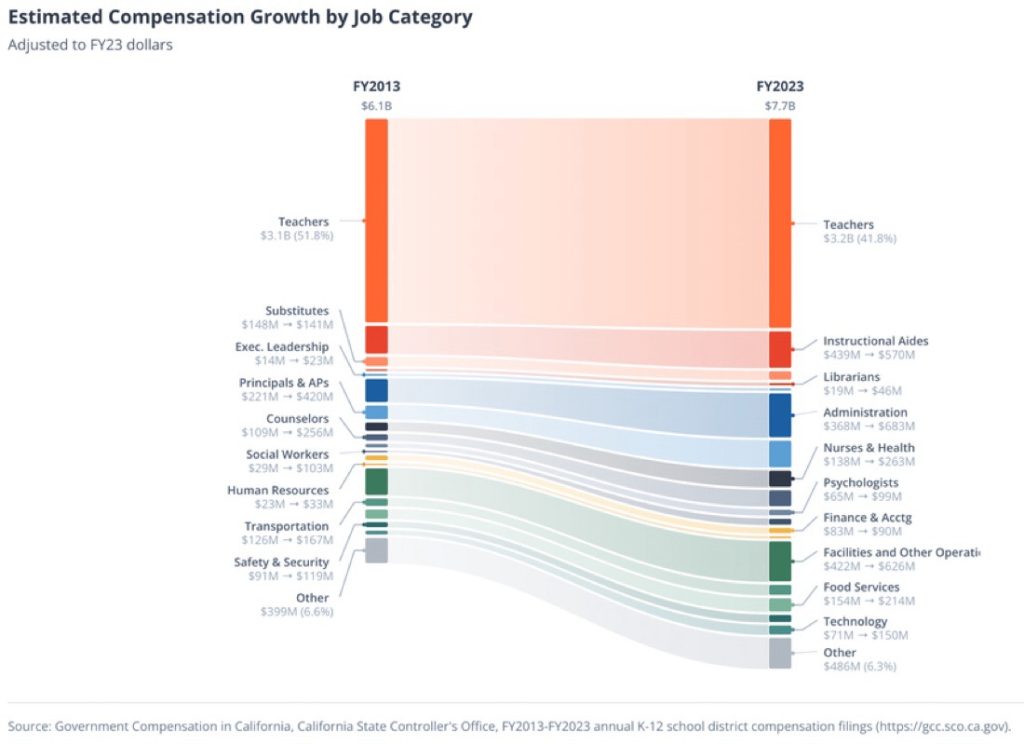
While losing 34% of its students, LAUSD’s spending on compensation increased by $1.7 billion
Los Angeles Unified School District’s recent labor agreements with United Teachers Los Angeles and other unions were hailed as a win for teachers, administrators, and service employees. But the district, which spends more money than it gets each year and is losing students, doesn’t have the funds to pay for it.
This isn’t for lack of funding: from 2002 to 2023, California led the nation in K-12 spending growth. The most recent federal data shows LAUSD spent nearly $27,000 per student in 2023. So why does the nation’s second-largest public school district have a billion-dollar structural budget deficit?
Analysis of data from California’s State Controller’s Office, which publishes employee-level payroll data for public school districts, counties, cities, and other government entities, shines a light on the causes of LAUSD’s structural deficit and how to fix it.
This analysis starts with an overview of our methodology, presents key findings, and discusses implications for LAUSD and state policymakers.
Methodology
We obtained all 11 years of LAUSD compensation data available from the California State Controller’s Office website, sorted job titles into 19 categories, and calculated inflation-adjusted spending on each category.
While LAUSD spending figures are available elsewhere, this data allows for greater nuance in evaluating compensation trends. However, it also has limitations. Because the dataset doesn’t distinguish between part-time and full-time employees, we do not report employee counts. And, because some job titles are vague and their categories can’t be confirmed, all figures presented are estimates.
Data Holdings is owned by the Forest County Potawatomi Community tribe in northern Wisconsin, as a subsidiary company of Potawatomi Ventures. The company’s customers include government, healthcare, hospitality and other organizations, according to Ryan Brooks, Data Holdings’ chief technology officer and general manager.
“The Tribe’s long-term perspective and commitment to responsible and sustainable investment helped shape the development of Data Holdings from the beginning and continues to influence how we operate and grow today,” Brooks told the Cap Times in an email.
Increased development of data centers and how to regulate the facilities has prompted debate in communities across Wisconsin and the nation, and percolated in the state’s fall elections, including in the gubernatorial race.
Data Holdings opened a two-story, 46,000-square-foot facility in Milwaukee in 2013. The scale of the building pales in comparison to some larger proposed data centers in Wisconsin, such as Meta’s facility in Beaver Dam, which is expected to span more than 500 acres.
At a campus meeting this month, faculty leaders asked interim Chancellor Eric Wilcots where the university stood on data centers.
In China there is plenty of funding for academics who are engaged in cutting-edge research in fields favoured by the Communist Party such as artificial intelligence and robotics. But the Harvard academic may be surprised to learn that on many campuses, the mood among staff is sullen. Eager though the party is to promote scientific endeavour, it is becoming more selective about who gets the state’s cash. In April the education ministry said that it had revoked 12,200 degree programmes in recent years, mainly in soft subjects such as “business management”, replacing many with majors in AI and other sciences that are the party’s priorities.
Documents reviewed by The Economist show that even in Shenzhen and Hangzhou, both big hubs of party-backed tech, universities have had their budgets cut by more than 5% this year.
Restoring happiness will be difficult. Increasingly, universities are adopting Western styles of employment, with academics often having to labour for years before being granted a permanent job, says Qiang Zha of York University. Some complain that, because of tighter budgets, universities are hiring junior staff to bolster research with no intention of giving them a permanent place. Getting a job or promotion in academia is now such a struggle that many quit. Shenzhen Middle School employs more than 100 staff with PhDs.
——-
“They were relieved that American classes are so much easier than those in Taiwan”
Madison’s district, despite an elite university pipeline, hypereducated leadership, and a shiny, new strategic plan, suffers the same frailties as Milwaukee’s: basement performance, backbreaking spending. But while Milwaukee is pulling out of its tailspin due to courageouschoices from the top, Madison is ponderously ambling to nowhere. Just ask the locals. “You need the marketing, and you need the product,” as a parent told a reporter. “I’m missing the product.”
2025-2026 Madison 4k-3rd grade Early Literacy Screener report: The bar moves faster than the kids.
2026-2027 Madison K-12 $pending continues to grow, fueled by a 9.7% (!) property tax increase. Total spending will be at least $706,000,000 for 25,003 students, or $28,236 per student.
May 2026 Madison School District Presentation: 7,095 adults for 25,003 students (3.52 students per adult!)
In November three men and a 17-year-old boy, all Afghans, gang-raped a 17-year-old girl over several hours. Beforehand they had groomed her on Snapchat and plied her with alcohol; afterwards they fled to France in a lorry. The French authorities returned them to Britain, where they were convicted and, on October 6th, sentenced to long jail terms. In court the girl described how “listening to it all again from the lawyers kept me reliving everything that happened to me”.
Such horrors fuel suspicion of migrants. So did a recent state-issued booklet about Britain for asylum-seekers. Page five clarified that the legal age of consent is 16 and that rape is a serious crime. “I’ve never heard of someone who decided not to rape because they received a leaflet,” said Kemi Badenoch, the Tory leader. The clumsy campaign fed the idea that some immigrants—notably men seeking asylum—are responsible for a disproportionate share of sex offences. Nick Timothy, the shadow justice secretary, claims that “Afghans are over TWENTY times more likely to commit sex crimes than Brits.”
Is that true? The government does not publish crime rates by immigration status. The limited data it does release are raw counts of offences by those of each nationality, from a country-wide police database. The “20 times” claim was based on there being 13,000 Afghans in Britain, an estimate from the Office for National Statistics’ Annual Population Survey. That figure is unreliable, however, having been extrapolated from a sample of fewer than 60 individuals. In 2021 the ONS stopped publishing this population estimate owing to plummeting survey-response rates.
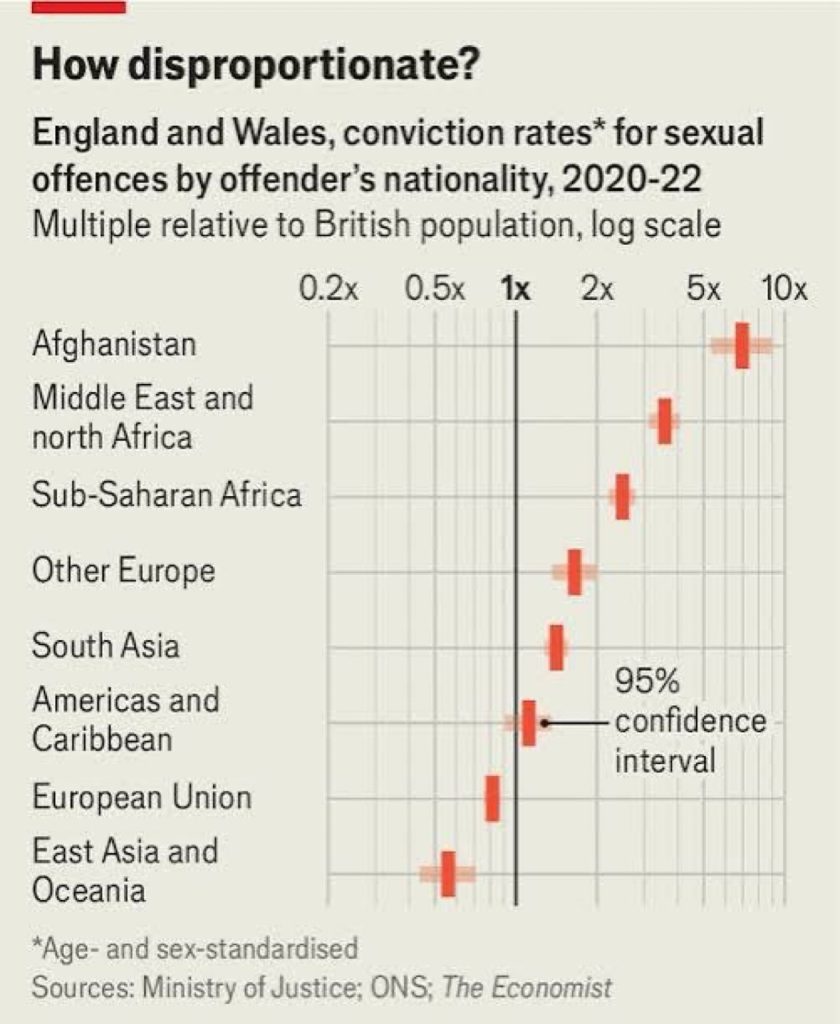
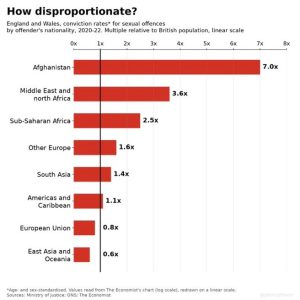
The Economist’s analysis suggests that the “20 times” claim is a wild exaggeration. But our numbers are hardly reassuring.
The Migration Observatory, a think-tank based at Oxford University, obtained figures through freedom-of-information requests to the Ministry of Justice. These count cautions and convictions in England and Wales, split by offenders’ nationality, between 2010 and 2024. The data detail 8m crimes, of which 106,000 are sex offences ranging from rape to consensual sex in public. The police’s recording of offenders’ nationality is messy, but we found that four-fifths of sex crimes were committed by British people. Just 0.39%—409 offences over the 15-year period—were committed by people who said they were Afghan.
Whether 409 crimes is a lot or a little depends on how many Afghans are in the country. In March 2021 the last census reported 14,300 Afghan passport-holders living in England and Wales, and another 7,100 without a passport who said they were Afghan: a total population of 21,400.
Richard Borcherds, a UC Berkeley professor and Fields medalist, no longer grades his students’ homework.
After seeing how many of his students used AI to consistently receive top scores, he felt there was “no point” in paying readers to grade for correctness in homework, as AI use is now unavoidable.
Borcherds revealed this in a sit-down interview Tuesday, following OpenAI’s announcement that AI agents apparently solved one of mathematics’ most difficult unsolved problems, the Navier-Stokes existence and smoothness problem.
“If AI continues to improve at present rate, then, in a few years, there’ll be nothing human mathematicians can do that AI can’t do better,” Borcherds said.
Borcherds said he currently grades on completion if a student hands in their homework. He admitted that it is “not a very good system,” but at the moment, he has no alternative.
Borcherds stated he no longer knows whether to encourage students to go into the math department, as it seemed five years ago that being a mathematician was one of the safest careers from the AI boom.
we are in an apocalyptic era; peter thiel wants you to study the bible, think harder about the antichrist, and (literally) save the world.
The Christianity of these lectures is central; they are necessarily Christian and rely heavily on Biblical descriptions of the end of history and the signs that herald its coming. Thiel says that he modeled them after John Henry Newman’s four-part 1835 lecture series, “The Patristical Idea of Antichrist.”
In one of the Q&A sessions with Peter Robinson, Thiel — affectionately referred to throughout as the “young” Peter, relative to the boomer-generation Peter Robinson — described himself as a “small-o orthodox Christian.” When asked if he believes that Scripture is “inspired,” he responds, “yes, it should be taken seriously, though sometimes not completely literally.” Thiel emphasized that we should study and reason about the Bible, rather than follow it blindly, and notes that one will find it to have a surprising resonance with our times. In a related discussion, he emphasized that the so-called “Great Books” are much lesser than the Bible and should not be worshipped. Instead, these books should be treated as tools to understand their times and must themselves be considered through the lens of the Bible. This approach sets up the ethos for much of the following lecture series.
The Christian eschatology that Thiel draws upon tells of an apocalyptic age dominated by a deceptive ruler referred to as the Antichrist — the portrait of this ruler is one constructed through an amalgamation of biblical sources and whose shape is up to some level of ecumenical interpretation.
Revelation tells of a beast from the sea, often interpreted as the Antichrist and his associated apparatus of power, and a beast from the land, who rises from the earth to persuade humanity to worship the beast from the sea and enforces this worship under threat of death. This latter figure is viewed as a kind of ideological or religious ally to the Antichrist, a false prophet.
Satan empowers the beast from the sea to exercise authority over all peoples, languages, and nations. It wages war against the saints, and all earthly kings surrender their power to it. From this, and other earlier biblical mentions, the image of the Antichrist as a one-world totalitarian dictator emerges. If the Bible is true, or at least “inspired,” how do we end up in such a dire situation, and what can be done to delay or prevent it, if anything?
The reign of these beasts precedes a final conflict in which Christ returns victorious; the Antichrist and false prophet are cast into a lake of fire. Christ then reigns for a thousand years, during which time Satan is bound. Satan is released after this epoch, briefly rebels, and is eternally defeated. God then passes final judgment on the dead, death and hell are cast into the lake of fire, and a new heaven and earth replace the old.
Let’s start with the only question that matters: what makes a political system work or fail? To a very large extent, it’s the economy. A country that produces wealth, that lets its citizens create, trade and build, stays standing. A country that destroys that collapses, no matter how beautiful its slogans are.
And in economics, there are really only two worldviews.
The first is collectivism. The idea that the State knows better than you. That it must plan production, set prices, run companies, decide what you earn, what you buy, and eventually what you think. The individual is just a cog serving a grand collective project: the class, the nation, the race, the people.
The second is freedom. Capitalism, property, individual liberty, individual responsibility. The idea that millions of people creating value for one another produce infinitely more prosperity than an office of planners, however brilliant they may be.
Now look at the list of the great totalitarian regimes of the 20th century. Stalin: total planning, forced collectivization, millions dead. Mao: the Great Leap Forward and the deadliest famine in human history. Pol Pot: money abolished, cities emptied, nearly a quarter of Cambodia’s population exterminated. Mussolini, the man who coined the word fascism: “Everything within the State, nothing outside the State, nothing against the State.” And Hitler, leader of the National Socialist German Workers’ Party, whose program proclaimed “the common good before individual good.” He subjected the entire German economy to State plans: the Four-Year Plan, frozen prices and wages, unions dissolved into a single state labor front, industrialists producing whatever the regime decided.
Their flags were different. Their designated enemies were different. But the machinery was the same: the individual doesn’t exist, only the collective matters, and the State decides everything.
Why does it always end in totalitarianism? Because collectivism doesn’t work. And when a system doesn’t work, it has only two options: admit failure or force people. They always choose force.
Ludwig von Mises proved it as early as 1920: without free prices, without a market, a planner simply cannot know what to produce, how much, or at what cost. He is flying blind. A planned economy isn’t a less efficient version of the market. It’s an impossibility.
In my previous article, I explained that England’s government seems determined to move away from a set of education policies that have been very successful, and that have attracted significant international attention.
In this post, I am going to explore the issue further. It’s a long post, split into 5 parts, so I’ve added internal hyperlinks here.
Let’s just review the policies that are changing.
There are two proposed policies that are getting a lot of attention. Neither of these has happened yet, and the details of how they will work are sparse.
Vocational qualifications. The government want to create new vocational qualifications for 14-16 year olds to study, and to incentivise these in league tables.
Oracy. The government want to increase the status of oracy – better known as speaking and listening – within the English curriculum.
There are two other policies which have already happened. These have not got that much attention, even though they are both pretty significant.
Below is my column in Fox.com on the recent MS NOW interview with Rep. Ilhan Omar. The most impressive aspect of the segment with Chris Hayes was how he could conduct an extended interview without actually asking long-standing, unanswered questions. When it comes to the art of evasion, it was a masterpiece. In case you are curious, here are the questions not asked of Rep. Omar.
Here is the column:
“I am trying to figure out the way to do this.” Those words from MS NOW’s Chris Hayes say all you need to know (and likely all you will get) from his interview on Wednesday with Rep. Ilhan Omar of Minnesota. There is a litany of questions the liberal host never asked of Omar. Those questions have only increased over the years, leading to the current criminal investigation into immigration fraud. At points, Hayes sounded more like a supplicant than a journalist given his discomfort with asking pressing questions.
The interview had the journalistic nutritional content of a Slurpee that would give any liberal a sugar high and any non-liberal a stomachache.
Many of us have stressed that these allegations are unproven, and that little evidence has been confirmed to support the underlying criminal charges. However, I have also written that Omar has been remarkably unforthcoming in rebutting the allegations or providing her own exculpatory information. Instead, she has spent years denouncing the allegations as racist or Islamophobic without addressing the specific claims.
While the Biden administration began aspects of these investigations years ago, Omar again sat for another prolonged interview without being pressed (beyond cursory questions) about long-standing allegations.
Inside the School Board Brawl Rocking Beverly Hills
Fierce local election in one of America’s wealthiest enclaves pits parent against parent in battle fueled by national politics
Before security escorted her out of a school-board meeting, parent Jackie Kruger—clad in a leopard-print jacket and wide-brimmed hat—warned the board’s president that she would sue.
“You got to do what you got to do, baby,” the president, Judy Manouchehri, shot back.
Welcome to the Beverly Hills Unified School District, home to one of the nastiest local races of the year, complete with flying insults, dueling restraining-order petitions and a yard-sign whodunit involving a white Tesla with a ski rack.
The women—both attorneys and mothers of three—will meet again Nov. 3, when Kruger tries to unseat Manouchehri. Kruger, 47 years old, accuses her 46-year-old rival of hurting schools in one of the world’s most star-studded cities and fostering a climate of fear.
“When you’re at rock bottom, there’s only one place to go,” Kruger said, eyes blazing, as she munched on grapes at home last week.
The Justice Department says two UCLA graduate schools, medicine and law, considered race in admissions after the Supreme Court banned the practice in 2023; UCLA denies it. The findings land as UC reconsiders its 2020 decision to drop the SAT, made over its own faculty task force’s objections, and as more than 3,000 UC faculty warn that incoming students lack basic math and writing skills.
WHAT THE JUSTICE DEPARTMENT FOUND
The law school. On Oct. 1, 2026, the department’s Civil Rights Division announced findings that UCLA Law discriminated against white and Asian applicants in admitting its 2023, 2024 and 2025 classes. The department says the school “rejected white and Asian applicants who had the same LSAT scores as admitted black and Hispanic applicants.” It also says that in 2024 and 2025 combined, “half of the admitted black applicants had LSAT scores that were at or below 90% of the admitted white applicants.” According to the findings, the school’s essay prompts were “designed to elicit information about race,” and admissions staff explained how to disclose race at recruitment events such as a “Diversity Admissions Open House.” (Findings letter)
The medical school. On May 6, 2026, after a review lasting nearly a year, the department concluded that Geffen’s leadership “intentionally selected applicants based on their race.” It reported that admitted Black and Latino applicants had lower median MCAT scores and GPAs than admitted white and Asian applicants. The findings letter cites internal emails, training materials, and a “guiding principles” memo that, according to the Los Angeles Times, instructed committee chairs to ensure representation of applicants who “identify as BIPOC.” The department has also joined a lawsuit against the medical school brought by Students for Fair Admissions and other groups.
Last week, the Reason Foundation released its annual “Public Schools Without Boundaries” report, which evaluates each state’s open enrollment laws and ranks them based on how closely they align with a list of seven best practices.
For the third year in a row (see here for 2024 and here for 2025), North Carolina tied with Maryland, Maine, and Alaska for last place with an overall score of 0/100 and a grade of “F.” Meanwhile, Iowa, Nebraska, South Carolina, and Vermont improved their open enrollment laws, with varying degrees of success.
Open enrollment is a form of school choice that lets parents choose a traditional public school for their kids instead of their residentially assigned one, provided there are open seats. Within-district open enrollment allows students to attend any school within their home district, while cross-district open enrollment allows them to attend a school in another district.
Open enrollment can generate a number of benefits for students, families, and schools themselves. Benefits can include:
How do American teachers teach? In 1995 and again in 1999, a team of researchers randomly selected Grade 8 math classes from across the country and hired videographers to film them. All in all one hundred sixty-four American lessons were recorded, analyzed, and then compared with hundreds of classrooms in Australia, the Czech Republic, Hong Kong, the Netherlands, Switzerland, and Japan.
This pair of studies, about thirty years old, offers the most reliable (certainly the most detailed) picture of what American math teaching actually looks like. It mostly looks like this:
Here’s this lesson’s itinerary, per the whiteboard:
Warm Up
Go Over Homework
Lesson 3-2, Writing Variable Expressions
Homework Assignment
The teacher explains terms, offers examples, leaves time for notes. Students ask for clarification. She asks questions and calls on kids to answer them. There’s about twenty minutes of this; she then assigns practice problems. This was “normal” American teaching in 1999, or at least one version of it: “Most U.S. teachers chose to spend a considerable portion of the beginning of the lesson reviewing and then practicing new material at the end,” the researchers wrote.
Has this normal teaching disappeared? Matt Yglesias thinks so: he detects “hostility to explicit instruction” and an unwillingness in America to “show kids how to do the problem and make them practice.” Emily Hanford, in the first episode of her latest series, similarly laments that “something else took hold” in place of direct instruction—inquiry pedagogies where teachers are mere “facilitators” while students “discover math principles” and “teach each other.”
American doctoral dissertations in history, literature, philosophy, arts and culture are becoming more critical of Western culture, even as fewer people complete them.
The number of humanities dissertations dropped 49% from a historic peak of 33,473 in 2015 to 16,951 in 2025, the American Academy of Sciences and Letters reported. The dataset overrepresents large research universities, with declines most pronounced at elite schools.
Meanwhile, the share of words tied to identity politics and social theory grew tenfold from 1960 to 2025, with a sharp acceleration after 2019. That includes terms such as “intersectionality,” “decolonization,” “patriarchy,” “oppression,” “queer,” “equity,” “diversity,” “whiteness,” “marginalization,” “privilege,” “diaspora,” “disability,” “gender,” “feminist,” “systemic racism” and “social justice.”
Alpha School, a fast-growing network of expensive private schools, promises to use A.I. to teach kids twice as much as they would learn in a traditional classroom in half the time. Academics take just two to three morning hours on a computer, freeing up the afternoons for workshops on vibe-coding, public speaking and sports.
The Trump administration has promoted Alpha as a model for “harnessing A.I.” to prepare tomorrow’s work force. Business leaders are talking it up on social media and podcasts, and some have signed up their own children.
For now, Alpha is a small, for-profit network, with lots of buzz and powerful backers, including the software billionaire Joe Liemandt. Its private schools serve about 1,500 students across 50 campuses.
But Alpha has huge ambitions to reach one billion students worldwide through its proprietary “A.I. tutor.”
The plan depends partly on extending its reach into public schools. Already, the Alpha software platform has been quietly adopted by several school districts in Texas and South Carolina, according to a company document reviewed by The New York Times. About 2,600 public school students are now using the software.
To reach more, Alpha needs to prove that its technology works for a broader range of children, beyond its core customer base of affluent, tech-enthusiast families. But as Alpha markets itself to districts and states, a growing number of educators, and former Alpha parents and employees, are questioning the effectiveness of the network’s high-tech, low-book model.
In March of 2026, in a nondescript, 46th-floor office overlooking lower Manhattan, about two dozen members of Scientific American’s editorial staff had gathered in person and online to talk openly about their approach to political coverage.
David Ewalt, the editor in chief, wanted them all to understand something: The magazine was not “kowtowing” to the Trump administration. In fact, according to a recording of the meeting obtained by The Nation, he asked staff present to “raise your hand if you’ve ever heard me say not to cover a political story.”
Two people raised their hands.
For well over a year, rumors had been circulating among the staff about top-level editors’ rejecting pitches they saw as too political, controversial articles triggering angry phone calls from Scientific American’s corporate owner, and even, on at least one occasion, ownership forcing editors to blunt language critical of the Trump administration.
Then there was what happened to the opinion department. In the first months of the new administration, it had been publishing about 15 pieces a month, many of which criticized Trump’s attacks on scientific research. But after the department published a particularly provocative column in May 2025—“Science Tells Us the U.S. Is Heading toward a Dictatorship”—management, in what one staffer would later call an “unprecedented” move, had told the department to “pause” publishing new articles until the new editor in chief started.
The opinion department’s hiatus had worried some people more than others—there were legitimate journalistic reasons to want to emphasize breaking news, even if not everyone agreed with them. But by March 2026, nine months into Ewalt’s tenure, the opinion section seemed to be gone for good—and other departments were feeling political pressure, too. That, along with a round of layoffs, a restructuring of the newsroom, and veiled threats about the future of the magazine, had left the staff frustrated and looking for answers. Now that the new editor in chief was finally coming to the full editorial staff “to listen as well as to speak,” as one staffer put it, they began asking questions.
Officially, DRG administered “democracy assistance.” They’d go inside countries they thought were sliding into authoritarianism and help the opposition there. That assistance included election monitoring, judicary support, independent media, and civil society building.
You may have heard the term “color revolution.” The model comes from Serbia in 2000, where trained student activists brought down Milosevic with the help of Western governments, after sustained protests. With the help of USAID’s democracy office, this model was implemented in many other countries to topple governments: Georgia’s “Rose Revolution” in 2003, Ukraine’s “Orange Revolution” in 2004, and many more.
Then last year, DOGE shut down USAID. But the USAID democracy office didn’t stop. They formed a group called the Democracy Renewal Group, the same initials as their office (USAID Democracy, Human Rights, Governance). Their goal: apply their own playbook to the United States itself.
This goal became a plan, called Renew American Democracy (RAD). It invoked the “4 B’s” framework. Block – use lawfare and protests to make life harder for the Trump administration. Bridge & Belong – control dialogue and win people over. The final and most important B is Build. Build means redesigning the American government itself, and the crisis is the opening.
In their own words: “We can take that breakdown moment and leverage it for a big structural reform, you know, refounding moment.” – Danielle Reiff, DRG lead.
That this stuff is out is probably the biggest deterrent to it happening. Many of the people in Data Republican’s records are probably under surveillance now, and possibly already named in sealed indictments. There’s also a “watch what you wish for because you might get it” angle to this: The Insurrection Act is powerful medicine and while it might play badly politically, the President’s powers under it are immense, and many Presidential powers — including deciding in the first instance which of two state governments is recognized as legitimate — are not subject to judicial review. Blue state governors might find themselves opposed by a new government in their state, loyal to the United States, that claims to be the legitimate government of the state and is recognized as such. (I’ve even suggested that something like this could lead to California splitting into two ore more states, following the precedent of West Virginia.)
Note that the plan is not for a coup, which as I’ve suggested is impractical in the United States: “In the classic coup d’état the nation wakes up one morning to hear that the political leadership has been arrested or co-opted, while the radio and television stations are under the control of the new regime. The civil servants go to work as usual, just following orders from a new batch of superiors. In the face of such a fait accompli, few are inclined to resist, particularly if, as is usually the case, the old regime wasn’t overly popular anyway.” A color revolution is not a coup, but it’s not really a civil war either — or at least it’s not meant to be. (I have some concerns that an attempted color revolution might lead to a civil war.)
The core documented funding streams for Elias’s litigation work remain the same: large foundation grants routed through Hopewell Fund plus direct legal-fee payments from Democratic Party committees (DCCC, DSCC, DNC, and aligned PACs). New 2025–2026 Form 990s and full-cycle FEC data will show any further increases once filed.
The civil rights arm of the U.S. Department of Education has dramatically scaled back investigations involving schools and colleges since the second Trump administration began, even as complaints continue to pour in, a ProPublica analysis of newly obtained records found.
The analysis shows how severely the department’s Office for Civil Rights has retracted from its mission, launching an average of about 100 new investigations a month — 1,839 total from Inauguration Day in 2025 through July 2026. The OCR launched an average of 310 new investigations each month in 2024 during the Biden administration, according to data previously obtained by ProPublica.
Yang found out about these materials from Jared Lederman, a Cornell senior who argued against Cornell’s approach to sex education and advocacy from a traditionalist-ish perspective on his Substack. “I have spent the last several years surrounded by the carefree sexual culture I am describing, and having watched what happens when sex is severed from commitment, I have come to believe that sexual intimacy belongs within a committed relationship, accompanied by loyalty, responsibility, and exclusivity,” he wrote. “I am not suggesting Cornell need adopt this outlook on sex; I am merely advocating it not espouse the polar opposite.”
I want to separate out the question of school-produced programming from the question of what sorts of events students at Cornell want to put on (Lederman does dip into the latter a bit). I think the latter is a silly thing to spend much energy worrying about. Student groups tend to have a set budget per year or semester, and if they want to put on some sort of pro-kink event, these are all legal adults (albeit young ones). As long as everything is safe and legal, and as long as the university doesn’t interfere when other students from different backgrounds want to put on, like, a pro-abstinence puppet show(?), who cares? Part of being a college student is figuring out what matters to you, whether and how you want to express yourself, and all that. I’d much rather colleges err on the side of laxity rather than nannying when it comes to student activities and speech, even on private campuses where schools can legally intervene more than they can on public ones.
Let’s be clear: If I’m not going to sleep with you, I don’t need to know anything about your sexuality. And children—who are not going to sleep with anyone—certainly don’t. Your sexuality is not sacred. It’s not a personality, it’s not a protected class of performance art, and it’s not the center of anyone’s moral universe but your own. Unless we are in a relationship, I am not obligated to acknowledge, affirm, or be exposed to your private desires—especially not in public, and especially not in front of children. This used to be understood. Now it’s called hate. No, We Don’t Owe You an Audience Sexuality belongs in the private realm. It is intimate by definition. If you feel compelled to wear your kink on your sleeve—or on a float, or in a first-grade classroom—you are not inviting understanding, you are demanding submission. You are violating others’ right not to participate.
I asked a half-dozen of the kids about their experiences in high school. They were relieved that American classes are so much easier than those in Taiwan. The language gap can be a challenge, but math and science classes are a breeze.
Was anyone bullied? They shook their heads: Arizona kids are nice. Then several students brought up food fights. Amanda Chen is a senior who has already been accepted to a university in Texas to play varsity tennis. “Kids start food fights so often,” she said. “They’ve thrown carrot sticks, tomato slices and a cheeseburger.”
The parents are more concerned. Not about food fights — though the idea perplexes them — but about the laxity of education. Arizona’s public schools rank among the lowest in the country for graduation rates and the third-lowest in spending per pupil.
Taiwanese families were enticed to the United States in substantial part by the promise of sending their children to American colleges. Now parents fret the Arizona educational system won’t help their kids get there. They’re nonplused that teachers sometimes wave off assigning homework to high school seniors; some schools allow seniors to take Friday afternoons off. The idea astonishes parents used to spending big sums on extracurricular prep.
Madison’s district, despite an elite university pipeline, hypereducated leadership, and a shiny, new strategic plan, suffers the same frailties as Milwaukee’s: basement performance, backbreaking spending. But while Milwaukee is pulling out of its tailspin due to courageouschoices from the top, Madison is ponderously ambling to nowhere. Just ask the locals. “You need the marketing, and you need the product,” as a parent told a reporter. “I’m missing the product.”
2025-2026 Madison 4k-3rd grade Early Literacy Screener report: The bar moves faster than the kids.
2026-2027 Madison K-12 $pending continues to grow, fueled by a 9.7% (!) property tax increase. Total spending will be at least $706,000,000 for 25,003 students, or $28,236 per student.
May 2026 Madison School District Presentation: 7,095 adults for 25,003 students (3.52 students per adult!)
North Korean defectors, Buddhist monks, and Twitter-famous quants
What do a North Korean defector, the first female Fields medallist, and a Buddhist monk-turned-therapist-influencer have in common? They all participated in the most prestigious high school math competition in the world: the International Mathematics Olympiad (IMO).
The 65th IMO has just come to a close (team USA won 🇺🇸) and I wanted to dig deep into the outcomes of the most successful participants from this competition.
Why do I care so much?
I was an enthusiastic but mediocre participant in the British Mathematical Olympiad (BMO) from 2008-2010. The best performers on the BMO go on to represent the UK at the IMO. Rather than describe how badly I did, I have just annotated the distribution of marks from an equivalent year. I was far from representing the UK. We must have had some geniuses on the team, I thought.
During my college fieldwork at a middle school in Waukegan, I saw how difficult life could be for the predominantly Black and Hispanic community—and how poorly the public schools served its children. Schools that could not deliver results further complicated life for students trying to break out of a vicious cycle of poverty and crime. The vast majority of parents and students I spoke with unequivocally supported school choice, despite being largely Democrats. They felt the pain of bad government more than affluent white liberals who benefited from more functional schools.
It was for these reasons that I decided to teach in this school district, despite understandable questions from family and peers about why I would choose a district with such an awful reputation. My education program named me Student Teacher of the Year, and I felt I could make the greatest difference in a district like Waukegan. In retrospect, this view was certainly naive and driven by a youthful degree of white guilt. But I never anticipated the racial animus that other white colleagues and I would face for trying to do right by the community’s children.
Resentment toward white teachers in Waukegan did not begin in a vacuum. It had a long history born of Black dissatisfaction with two elements of the school district:
Student achievement and academic proficiency, particularly for Black students, whose proficiency rates on state assessments in ELA and math often ranged from 9% to 13%.
Racial disparities in disciplinary data: to put it bluntly, Black students, particularly Black males, were “overrepresented” in office referrals and disciplinary actions.
I disagreed with those who blamed teachers for these problems rather than examining district leadership, bureaucracy, and sociocultural problems in the Black community. But I understood the frustration. Hell, I didn’t have children in the district, and I had become increasingly disillusioned with the system myself. What frustrated me was that these difficult questions always ended with the same scapegoats: white teachers and racism. To suggest anything else was heresy—evidence of the very “racism” we were charged with.
This fall, voters in 72 Wisconsin school districts will decide whether to add more than $1.6 billion in new property taxes, in state where property taxes are already among the highest in the nation, via referenda. At a time when Wisconsin taxpayers already spend nearly $18,750 per student on average, a key question for voters is whether the case for still more funding has been made. While the number of districts going to referendum is lower than in the last major fall cycle, the dollars at stake remain large, and the arguments districts are making deserve closer scrutiny than they have often received. Among the key takeaways from this analysis:
Wisconsin’s fall 2026 referenda total more than $1.6 billion in new costs in 79 school districts.Claims that districts have fallen behind inflation often ignore total revenue growth.
Districts that already had higher baseline funding in 2019–20 were more likely to go to referendum overall, undercutting the idea that only cash-strapped districts are forced to ask.Recurring referenda in particular were more common in higher-funded, larger-enrollment, lower-poverty districts that fit a suburban profile.
Non-recurring referenda were associated with higher baseline funding plus enrollment decline, while referenda to issue debt were less common in better-funded districts. Voters face repeated large asks against already high per-student spending, so the burden remains on districts to show that existing resources have been used well before seeking more.
NYC schools Chancellor Kamar Samuels rallied his audience at a press conference this month, chanting the rousing line several times.
Samuels himself did not always “say public,” sources confirm.
Never mentioned and missing from his bio, Samuels sent his son to The Browning School, a prestigious private all-boys college prep institution on the Upper East Side, for six years– kindergarten through 5th grade.
Browning’s tuition in 2019-20, when Samuels’ son last attended, was $54,150. This year, it is $68,910.
Educator John A. Browning founded The Browning School in 1888 to instruct John D. Rockefeller and brother Percy. Alumni include Howard Dean, ex-Vermont governor, Arthur Ochs Sulzberger Jr., former publisher of the New York Times, and Jamie Dimon, the chairman and CEO of JPMorgan Chase.
The school for 400-470 students boasts small class sizes, rigorous academics and a focus on character.
Abstract:The functioning of complex systems depends on the coordination of diverse components, often supported by regulatory structures that incur costs. In human organizations, such costs manifest as administrative burden, which has been rising despite often reducing efficiency. Classic explanations point to bureaucrat self-interest or regulation, yet they do not explain variation across organizations or clarify how this burden can be reduced. Here, we develop a dynamical model of administrative growth that integrates known behavioral mechanisms of process creation, obsolescence, and removal. The model conceptualizes processes as developed for problem solving, but becoming obsolete as conditions change, while continuing to consume resources until actively pruned. This interplay generates two long-term outcomes: stable equilibrium or run-away growth. The threshold separating these outcomes is shaped by organizations’ propensity to create new processes when faced with problems, and their propensity to prune obsolete ones in response to administrative burden. Importantly, their effects are asymmetric: sufficiently high creation propensity leads to bloat regardless of pruning propensity. Faster environmental change shifts this threshold, making bloat more likely. Simulations of interventions show that lasting reductions in administrative costs and waste require permanent shifts in priorities and investments in distinguishing obsolete from useful processes. Temporary efforts or indiscriminate cuts provide only short-lived relief, and counterintuitively, prioritizing direct production can increase waste. Our work highlights a general mechanism by which well-intentioned problem-solving can create self-reinforcing inefficiencies in complex systems, offering insights possibly generalizable to broader applications, such as legal, policy, and software systems where obsolete elements accumulate.
After conducting an extensive literature review on the nature, causes, and ramifications of the crisis, our team decided to use natural language processing to analyze the terminology employed in American PhD dissertations in the humanities and social sciences, written between 1960 and 2025. Our premise was that PhD dissertations, written within a given field at a given time, provide a uniquely clear window into the language and underlying conceptual assumptions dominant in that field at that time. This is because dissertation writers, seeking approval and certification by committees of senior disciplinary scholars, must be acutely attentive to what they perceive to be the terminological and conceptual norms of their chosen discipline. Our hope was that using computational methods to track changes over time in dissertation terminology, and the valuation of certain terms, based on the verbal context in which those terms were deployed, would reveal patterns that bear on the questions that the AASL Committee was charged with investigating. This report, jointly written by Ober, George, and Kalinin, is the result of our work.
The University’s newest class of first-year students stands out in many ways — a record-high 82,087 applications resulted in a record-low 13 percent offer rate. The Class of 2030 is also the first admitted undergraduate class since the University reached a deal with the U.S. Department of Justice in October 2025.
The University’s deal with the Justice Department suspended five federal civil rights investigations under the agreement the University would dissolve its Office of Diversity, Equity and Inclusion and similar programming. Further, the University agreed to remove diversity language from its communications in accordance with federal anti-discrimination law, and it is required to submit quarterly compliance reports detailing its “good-faith efforts” to comply with federal civil-rights law.
According to data from the University’s Institutional Research and Analytics unit, the newest class consists of 847 Asian students and 1,783 White students — 21.4 and 45.1 percent of the class, respectively. There are 375 Hispanic students in the Class of 2030, which is 9.5 percent of the class. Further, the Class of 2030 has 189 African American students, comprising 4.8 percent of the class. This percentage is down from 6.1 percent African American students in the Class of 2029, and down 3.4 percentage points from the Class of 2027 figure of 8.2 percent.
Last year and in years prior, the University reported limited demographic and other information about the newest undergraduate class in the form of an article in U.Va. Today. Last year’s article was published Aug. 25, 2025, and no comparable class profile article has been published for the Class of 2030.
University Spokesperson Bethanie Glover told The Cavalier Daily in a written statement that the types of stories the University publishes about incoming classes change over time.
“U.Va. Today’s coverage strategy is flexible,” Glover wrote. “For the Class of 2030, the U.Va. Today team shared stories related to Class offers, events to welcome the Class to Grounds, and move-in tips that students and their families might find valuable as they plan their trip.”
The Pentagon last month designated five institutions as distinguished military colleges. Hillsdale College, Liberty University, Louisiana State University, Mississippi State University and Tuskegee University join the six congressionally designated senior military colleges in what Defense Secretary Pete Hegseth is calling America’s Corps of Cadets. The schools will establish self-governed student cadet corps programs similar to those of senior military colleges that offer rigorous military education and tactical training.
The distinguished military college designation predates World War I but was dropped in the mid-20th century. At the time, the War Department recognized schools such as Pennsylvania Military College and LSU as distinguished military colleges based on an annual formal inspection of their corps of cadets programs, facilities and instruction. Mr. Hegseth’s new initiative should restore similar metric-based assessments.
The U.S. Army ROTC began with the National Defense Act of 1916 and was later extended to include programs for the Navy and the Air Force. These programs provide students with military classes and training at civilian universities alongside civilian college degree requirements. Those who complete the program and meet service requirements can be commissioned as officers.
The six existing senior military colleges—Norwich University, Texas A&M, The Citadel, University of North Georgia, Virginia Military Institute and Virginia Tech—maintain university-run full-time corps of cadets alongside their federal ROTC programs. Cadets live under military discipline throughout the academic year, attending formations, maintaining their rooms and uniforms for inspection, and assuming responsibilities within a cadet chain of command beyond scheduled ROTC training.
The argument that property taxes make Americans renters in their own houses has fueled the biggest anti-tax uprising in half a century, and local governments are scrambling.
A rebellion sweeping the nation gathered adherents in the parking lot outside northeast Ohio’s largest flea market on the Saturday before Memorial Day. Before making their way to stalls selling whirligigs, handmade soap, and peanut-butter Buckeye brownies, dozens of people stopped at folding tables where volunteers hawked petitions to abolish property taxes. Few needed much convincing before adding their names.
“I’m old. I’ve paid my home off,” said Ray Warner, a 72-year-old Akron resident wearing a Cleveland Browns coat to fend off the damp chill. “Why would I pay property tax?”
Across the country, homeowners are asking the same question. Fueled by the rising cost of homeownership — soaring home prices, mortgage rates and insurance bills — they are revolting against property taxes at a scale not seen in a half century. The 1970s property tax uprising that one journalist called a “Revolt of the Haves” reshaped American politics. The depth and breadth of today’s proposals threaten to do so once again.
In the last two years alone, plans to substantially reduce or altogether repeal property taxes have emerged in more than two dozen states. Georgia, Indiana and Wyoming already sliced residents’ tax bills by billions of dollars. Republican governors Ron DeSantis and Greg Abbott have Florida or Texas competing to see who can lower property taxes the most. Gubernatorial candidates elsewhere are putting tax reform at the center of their campaigns in the hopes of staving off insurgencies that risk overrunning their tenures. Public figures as disparate as Elon Musk, the world’s richest man, and Francesca Hong, the socialist who narrowly lost the Wisconsin Democratic gubernatorial primary, have joined the cause.
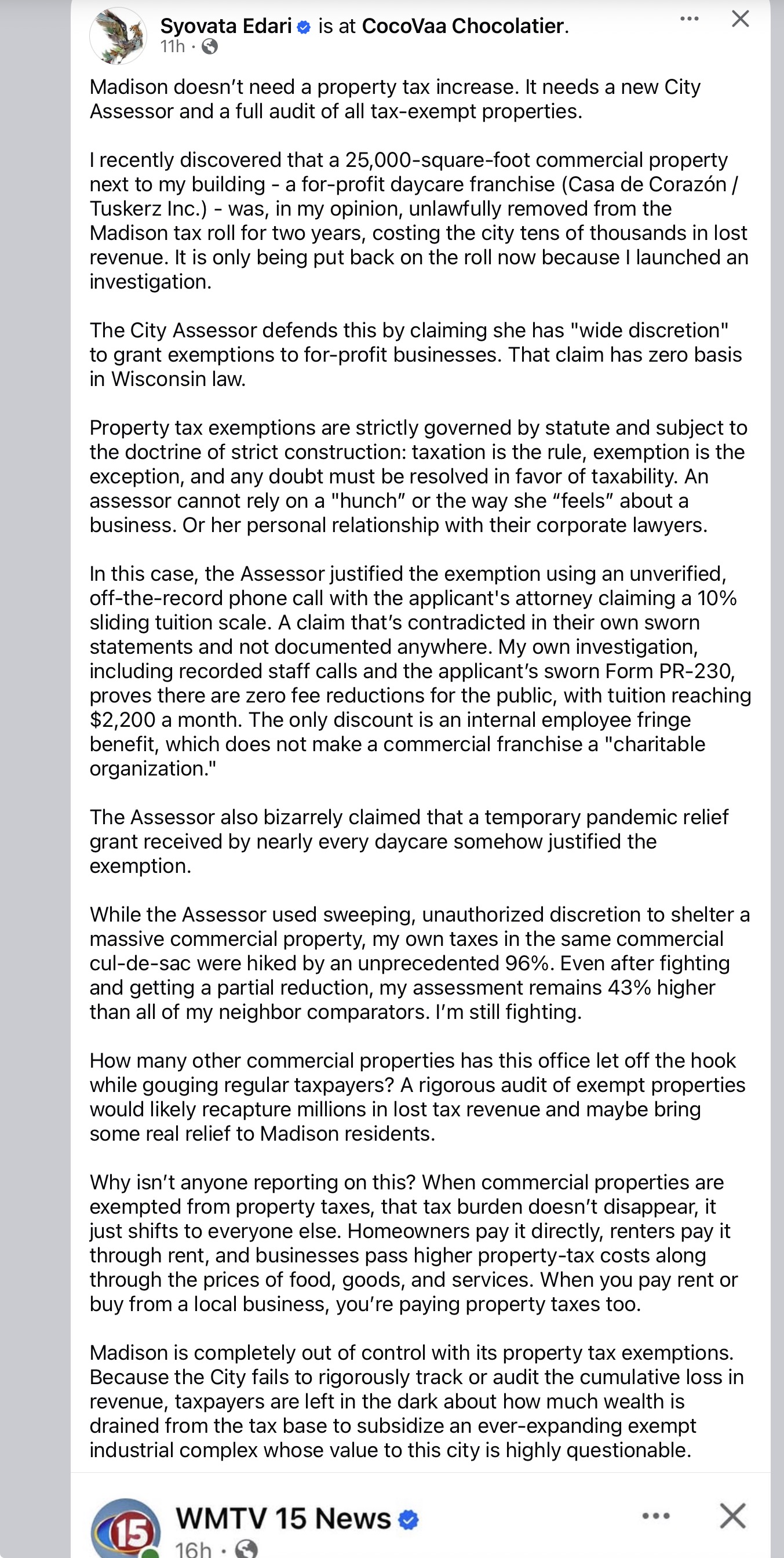
Madison doesn’t need a property tax increase. It needs a new City Assessor and a full audit of all tax-exempt properties.
I recently discovered that a 25,000-square-foot commercial property next to my building – a for-profit daycare franchise (Casa de Corazón / Tuskerz Inc.) – was, in my opinion, unlawfully removed from the Madison tax roll for two years, costing the city tens of thousands in lost revenue. It is only being put back on the roll now because I launched an investigation.
The City Assessor defends this by claiming she has “wide discretion” to grant exemptions to for-profit businesses. That claim has zero basis in Wisconsin law.
Property tax exemptions are strictly governed by statute and subject to the doctrine of strict construction: taxation is the rule, exemption is the exception, and any doubt must be resolved in favor of taxability. An assessor cannot rely on a “hunch” or the way she “feels” about a business. Or her personal relationship with their corporate lawyers.
In this case, the Assessor justified the exemption using an unverified, off-the-record phone call with the applicant’s attorney claiming a 10% sliding tuition scale. A claim that’s contradicted in their own sworn statements and not documented anywhere. My own investigation, including recorded staff calls and the applicant’s sworn Form PR-230, proves there are zero fee reductions for the public, with tuition reaching $2,200 a month. The only discount is an internal employee fringe benefit, which does not make a commercial franchise a “charitable organization.”
The Assessor also bizarrely claimed that a temporary pandemic relief grant received by nearly every daycare somehow justified the exemption.
While the Assessor used sweeping, unauthorized discretion to shelter a massive commercial property, my own taxes in the same commercial cul-de-sac were hiked by an unprecedented 96%. Even after fighting and getting a partial reduction, my assessment remains 43% higher than all of my neighbor comparators. I’m still fighting.
How many other commercial properties has this office let off the hook while gouging regular taxpayers? A rigorous audit of exempt properties would likely recapture millions in lost tax revenue and maybe bring some real relief to Madison residents.
Why isn’t anyone reporting on this? When commercial properties are exempted from property taxes, that tax burden doesn’t disappear, it just shifts to everyone else. Homeowners pay it directly, renters pay it through rent, and businesses pass higher property-tax costs along through the prices of tood, goods, and services. When you pay rent or buy from a local business, you’re paying property taxes too.
Madison is completely out of control with its property tax exemptions.
Because the City fails to rigorously track or audit the cumulative loss in revenue, taxpayers are left in the dark about how much wealth is drained from the tax base to subsidize an ever-expanding exempt industrial complex whose value to this city is highly questionable.
Madison’s district, despite an elite university pipeline, hypereducated leadership, and a shiny, new strategic plan, suffers the same frailties as Milwaukee’s: basement performance, backbreaking spending. But while Milwaukee is pulling out of its tailspin due to courageouschoices from the top, Madison is ponderously ambling to nowhere. Just ask the locals. “You need the marketing, and you need the product,” as a parent told a reporter. “I’m missing the product.”
2025-2026 Madison 4k-3rd grade Early Literacy Screener report: The bar moves faster than the kids.
2026-2027 Madison K-12 $pending continues to grow, fueled by a 9.7% (!) property tax increase. Total spending will be at least $706,000,000 for 25,003 students, or $28,236 per student.
May 2026 Madison School District Presentation: 7,095 adults for 25,003 students (3.52 students per adult!)
…… but they’re also gaining knowledge at something like 10x the rate of anybody else so they aren’t just miles ahead, they’re pulling away.
That, I think, speaks really eloquently to what is the most valuable part of the Elon Musk ethos — that you move so fast that you accumulate knowledge at a rate that is completely different than anybody else. Their cumulative knowledge is extraordinary.
This week Chris sits down with Ross Perot Jr., Chairman of Hillwood and The Perot Group. Ross founded Hillwood in 1988 and built Alliance Texas, his masterpiece, a 1 of 1 27,000-acre development.
The school board voted last year to eliminate ninth-grade honors biology, placing all students in the same class and asking teachers to “differentiate” instruction for students at different levels.
“Merging courses promotes equity by ensuring all students have access to the same foundational coursework and higher expectations,” according to supporters, Gibbs writes. It removes the stigma of non-honors classes.
But two of the three candidates for two open school-board seats oppose de-laning. “People go to private school and that takes dollars out of the public school system,” said John Craig, an engineer. Tech executive Avery Wang also promises to maintain honors classes. The third candidate, Linda Henigin, a teacher’s aide, said she sides with detracking but also wants students to have access to advanced courses.
“Craig and Wang are part of a larger group of school board candidates across the Bay Area running on the promise to push back against the trend in the region’s school districts — including in Oakland Unified, Fremont Union, Morgan Hill Unified, San Francisco Unified and Los Gatos-Saratoga Unified,” reports Gibbs.
These are just a few of the 2,015 reports of student-on-student sexual misconduct that occurred at Boston Public Schools over a six-year span (2018-2019 to 2023-2024) — documents that BPS officials have done their best to keep from seeing the light of day.
The number of reports would have been significantly higher were it not for two factors. First, during the COVID-19 pandemic, BPS ceased in-school classes for about a year. Second, as explained later in this report, incidents of sexual misconduct are greatly underreported for a multitude of reasons.
The first five years of records were secured only after a lawsuit was filed against Boston Public Schools in Suffolk Superior Court by a freelance reporter represented for the initial portion of the litigation by the Pioneer Institute. The reports for the sixth year were obtained in response to a public records request filed subsequent to the conclusion of the lawsuit. (BPS officials demanded $1,600 for school years 2024-2026, which the freelance reporter was not in a position to pay.)
A study published Wednesday finds that American doctoral dissertations in history, literature, philosophy, arts and culture are becoming more critical of Western culture, even as fewer people complete them.
The American Academy of Sciences and Letters reported that humanities dissertations dropped 49% from a historic peak of 33,473 in 2015 to 16,951 in 2025. The dataset overrepresents large research universities, with declines most pronounced at elite schools.
Meanwhile, the share of words tied to identity politics and social theory grew tenfold from 1960 to 2025, with a sharp acceleration after 2019. That includes terms such as “intersectionality,” “decolonization,” “patriarchy,” “oppression,” “queer,” “equity,” “diversity,” “whiteness,” “marginalization,” “privilege,” “diaspora,” “disability,” “gender,” “feminist,” “systemic racism” and “social justice.”
Cornell University has long been an example of an academic echo chamber where conservative and libertarian faculty have been largely purged from departmental ranks. For example, a study by The College Fixfound that Democrats outnumber Republicans 98 to 1 among Cornell professors across six of the humanities departments. Cornell professors disrupt events, launch campaigns to fire the remaining conservative faculty, and foster a cancel campaign culture on campus. However, the faculty recently decided to review its own record and found . . . wait for it . . . that there really are no concrete measures needed to address their own overwhelming ideological bias.
According to a 238-page faculty report from the Committee on the Future of the American University, there was no consensus on ideological bias or how to handle it. Moreover, some faculty members insist that, while there is an ideological imbalance, it is not a problem because liberal faculty can offer explain or incorporate conservative values when needed.
The report boldly states that “[t]his report asks how the university must adapt to honor its quietly revolutionary purpose in American life. The answer cannot leave the university exactly as it is today.” However, one thing apparently does not have to change: the faculty’s ideological orthodoxy.
The report has that certain feel of an academic confab product, including a self-congratulatory observation that “disagreements did not curdle into outrage.”
The report acknowledges the ideological diversity problem but leaves it maddeningly undeveloped and ultimately unaddressed:
In the autumn of 2024, Annie was ready for something new. She was living in the southern United States when her husband received an unexpected job offer that would move them to a town just outside London. They were in their twenties with no kids. “We wanted to take a risk,” she says.
While researching their new destination on Reddit, TikTok, and Instagram, Annie found Americans eager to explain how enchanting life in the British suburbs could be—all the benefits of a small town, just a short train ride away from one of the biggest cities in the world. The more she read, the sunnier her expectations about the UK’s health care system, social culture, and European transportation systems became.
They moved before the end of the year. But the reality of life in the UK was dramatically different to what she’d imagined. “There are huge misconceptions about access to quality health care, standard of living … the quality of life is significantly lower than in the US,” she says, citing the challenges she experienced with the National Health Service’s maternity care—having moved while pregnant with her first child—as well as the lack of disposable income in Britain, thanks to lower salaries. “Things in the UK that are considered luxury items are very common” in America, like a dishwasher and dryer, she adds.
Annie says she experienced a high amount of anti-American sentiment straight away. “I found it particularly surprising how people feel so comfortable mocking my accent and culture, even in a workplace environment,” she says. “The UK is very much a place of ‘it is what it is,’ but as Americans we are taught to always improve and strive for better things.” Annie and her husband now have an exit plan for summer next year, the earliest their employers would allow them to relocate back home.
The flagship law review at the University of California, Berkeley, is poised to delete all internal application records after the Washington Free Beaconreported on the journal’s use of personal statements to promote a “diverse membership,” sparking concerns that the journal is attempting to destroy evidence that could be used against it in the event of a discrimination probe.
The California Law Review will vote tomorrow on a document retention policy that would require the journal to delete all “Write-On application materials following the conclusion of each year’s Write-On process,” as well as any materials related to the election of the journal’s Holistic Review Committee, an eight-person body that grades applicants’ personal statements, according to a source familiar with the situation.
Members of that committee have pledged in writing to “uplift Native voices,” weigh “diverse life experience” against “technical editing abilities,” and “integrate anti-racist sentiment” into the selection process, the Free Beacon reported in August. The proposed policy would eliminate any record of those pledges, making it harder to sue or investigate the journal for race discrimination.
At least one editor has argued that the move would raise legal concerns about the destruction of evidence and could expose students to criminal liability.
“[I]t seems that the provisions relating to designated communications and to candidate statements could be construed as being intended to avoid the creation of the kind of evidence that was recently leaked to the Washington Free Beacon, and to bar editors from reporting it,” the editor wrote in an email to the law review on Tuesday. “If I were a federal prosecutor or immigration services officer, I might regard this as a system designed to enable violation of the civil rights laws by engaging in discrimination on racial and other grounds through the selection of [Holistic Review Committee] members that publicly stated their intent to do so.”
This week the U.S. Department of Justice, Civil Rights Division and the U.S. Department of Education, Office for Civil Rights (ED-OCR) entered a voluntary university-wide settlement agreement with the University of North Carolina at Chapel Hill (UNC) to end antisemitism and race discrimination. The settlement agreement resolves investigations conducted by the Civil Rights Division and ED-OCR under Title VI of the Civil Rights Act of 1964, which prohibits discrimination based on race, color, or national origin (protected characteristics).
“Title VI requires that all students — regardless of their ancestry or race — receive equal treatment under the law at federally funded colleges and universities,” said Assistant Attorney General Harmeet K. Dhillon Justice Department’s Civil Rights Division. “Higher ed policies and practices that tolerate antisemitism or favor certain racial groups over others, frustrate our color-blind justice system. The Civil Rights Division commends UNC for its cooperation in meeting its obligations under federal law without the need for litigation; we hope other institutions will take note and do the same.”
“Today’s agreement with the University of North Carolina Chapel Hill is an important step in upholding civil rights laws and restoring the American people’s confidence in higher education,” said Assistant Secretary Kimberly Richey of the Department of Education’s Office for Civil Rights. “The Trump Administration is holding schools accountable for antisemitism at American universities and ensuring that institutions, which have no problem accessing generous taxpayer support, follow all federal laws and ensure safe learning environments. Because of today’s agreement with UNC, aspiring students will be assessed based solely on their merit — not race — and Jewish students can thrive without the threat of antisemitic discrimination.”
Under the settlement agreement — which applies to all undergraduate, graduate, professional, and other schools, components, and programs — UNC will take several steps in key areas:
Estrangements between adult children and their parents are on the rise in the U.S., creating “a cultural tipping point,” according to William Doherty, a therapist and professor emeritus of family social science at the University of Minnesota, who spoke to WSJ’s Elizabeth Bernstein about it. Readers debated the reasons for the social shift—and whether it’s a problem exacerbated by social media or therapists themselves. Here, edited for space and clarity, are a selection of those comments.
I am a small town 70-year-old psychiatrist. I have seen many hundreds of patients horribly abused or neglected as children who rightfully abandoned their parents. I have only seen a couple of patients emotionally nourished as children who abandoned their parents. I see far more cases of adults horribly abused as children who cling to their former or active abusers due to a “trauma bond.” I suspect the rate of unfounded rejection as well as the rate of founded rejection of parents varies dramatically by location and socioeconomic class. Unfounded rejection of parents is likely the result of privilege (often encouraged by well-meaning therapists) while founded rejection of parents is much more common among those without privilege. Of course there are exceptions.—Joel Rice
Early one gray morning in late April 2026, I found myself walking around Copley Square alone, cheering.
I was in Boston for a gathering of people from across the political spectrum worried about the future of small-l liberalism. The city had gone unusually cold overnight, which suited me fine. The Irish, British, and Russian parts of my family tree have never entirely understood why other people complain about gray skies. I went out for coffee before the conference sessions started, and it was just cold enough that I could occasionally see my breath whenever I laughed or took a sip. It made the effect more theatrical than the weather probably deserved, which was unfortunate for anyone hoping not to notice me. My laugh has never been accused of subtlety. To people crossing Copley Square, I probably looked like an overcaffeinated man listening to a playoff game.
But I was actually listening to Yale’s newly released Report of the Committee on Trust in Higher Education, which I had converted to an audio file from a PDF, something I do all the time (it lets me keep moving). And every so often, I literally cheered in response to what I was hearing.
Yale president Maurie McInnis had appointed ten faculty members to investigate why Americans had lost so much trust in higher education and what Yale itself ought to do about it. She also gave them wonderfully dangerous instructions for any committee: “think big, tell the truth, and entertain controversial ideas.”
They did.
The report confronted problems FIRE and I have been talking about for much of my twenty-five-year career: political homogeneity, free speech, self-censorship, grade inflation, administrative bloat, academic rigor, and the increasingly murky question of what all this enormous institutional machinery was actually for.
It cited a ratio of thirty-six registered Democrats to every Republican across Yale’s Faculty of Arts and Sciences, Law School, and School of Management. That’s bad, though hardly the worst in elite higher education. Nearly a third of Yale undergraduates did not feel free to express their political beliefs on campus. The median grade was an A. Yale’s published annual cost was $94,425 plus travel. And the real amount of money Yale spends per student per year is probably closer to $200K–which may sound nice until you realize how many students that amount of money could educate the hell out of if spent more judiciously.
But what had me cheering was the premise underneath the report, which was that maybe the public had noticed something.
This sounds like a very low bar until you’ve spent a quarter century watching higher education respond to criticism. I’ve often joked about what I call the Silver Spoon Rule. The name owes a little to the Golden Rule, but much more to the rules preferred by the silver-spoon set: It can never, ever, ever be elite higher education’s own fault… even when it obviously is.
And to my delight, Yale had broken the Silver Spoon Rule.
Until recently, I thought my worst New York City experience was the time I was waiting to cross Houston Street and a cackling vagrant punched me in the face. That, however, was before I started the process of getting my oldest kid into a public high school.
New York has an almost purely school choice system; most families don’t have a default high school that they’re zoned for. The admissions process, a mix of meritocratic culling and sheer chance, is time-consuming, psychologically taxing and so byzantine that it’s hard to describe to anyone who hasn’t endured it.
“I was somehow holding it together with all the balls in the air until this high school process,” Eva Pinkley, a single mother in Brooklyn, told me last week, as her neurodivergent son worked on an application essay with a coach she could barely afford. Now, she said, “I’m completely falling apart.” An education reporter I know contemplated moving out of the city after seeing high school applications up close. Friends of mine who’ve endured the process say the only consolation is that it makes applying to college seem easy.
I’d heard how miserable it was before it was my turn, but was still shocked by it, in part because of a stroke of particularly bad luck. My kid will, I think, be fine — I will go to great lengths to assure it — but I’m not sure how people with fewer resources cope. And the whole nightmare made me curious about how it got this way, and who all this punishing complexity serves.
Madison’s district, despite an elite university pipeline, hypereducated leadership, and a shiny, new strategic plan, suffers the same frailties as Milwaukee’s: basement performance, backbreaking spending. But while Milwaukee is pulling out of its tailspin due to courageouschoices from the top, Madison is ponderously ambling to nowhere. Just ask the locals. “You need the marketing, and you need the product,” as a parent told a reporter. “I’m missing the product.”
2025-2026 Madison 4k-3rd grade Early Literacy Screener report: The bar moves faster than the kids.
2026-2027 Madison K-12 $pending continues to grow, fueled by a 9.7% (!) property tax increase. Total spending will be at least $706,000,000 for 25,003 students, or $28,236 per student.
May 2026 Madison School District Presentation: 7,095 adults for 25,003 students (3.52 students per adult!)
In her 23-year career as a journalist and Pulitzer Prize winner, Nikole Hannah-Jones had never asked herself that question before. Then again, she told me, she had never written a piece as personal and vulnerable as her September article in The New York Times Magazine, “In Fighting For Every Child, Did I Betray My Own?”
The 8,000-word piece grapples with the consequences of her and her husband’s decision to enroll their daughter, Najya, in predominantly Black, low-income schools in New York City. The article is a follow-up to one Nikole wrote 10 years ago about Najya, who is now a teenager — and who now disagrees with her parents’ schooling decisions for her.
To write the piece with integrity, Nikole said, she had to lay herself bare — and, in doing so, exposed herself and her daughter and effectively handed ammunition to critics of hers and her choices. So for a quick minute, as she read some of the online criticism of the article, she wondered if it was worth it.
I recently spoke with Nikole about that, what went into writing the piece, readers’ reactions and whether she agreed with any of the criticism. Our interview has been edited and condensed for length and clarity. (A slightly more condensed version of the interview is available as a video.)
PATRICK HEALY: You had to make the decision about whether to put a very public spotlight on your daughter. How did you go about making that decision?
NIKOLE HANNAH-JONES: With the original essay, I had never intended to write about our family’s experience. But then our school became embroiled in this national integration fight. I had been covering these issues since my first job, and it seemed impossible not to write about it.
Do you trust the news? The New York Times at UW–Madison
On September 15, three New York Times journalists spoke at UW–Madison’s Pyle Center about why trust in the news is low and what they do about it: editor Patrick Healy, White House correspondent Zolan Kanno-Youngs, and Chicago bureau chief Julie Bosman.
“Now you are the head of that system, a system that despite what Mayor Mamdani promised during his campaign, remains under mayoral control, and so there is no buck to be passed now,” she said, to a swell of applause. “You have the system. So while I appreciate the work you have done today, we want to talk about the work you will do.
“I don’t think anybody here tonight came to hear platitudes or vague proclamations,” she added.
Hannah-Jones made waves among educators and parents last month with an essay in The New York Times about her decision to send her daughter to a majority-Black, low-income school. While hailed by many as a clarion call for integration of schools in the city, Hannah-Jones herself wrote of how she now questioned herself for making that decision to send her daughter to the school. Tuesday night’s town hall brought much of the private discussion of the story to a head, bringing together the writer, Samuels, students, parent leaders and advocates to debate how the city can advance school integration.
Samuels repeatedly defended his community-driven approach to integration, citing working groups that are developing proposals focused on integration and academic rigor. He said the administration is laying the groundwork by engaging communities, establishing structures for those conversations and building the capacity of superintendents who will lead the work.
“I don’t believe the best way to integrate schools is by large proclamations,” he said. “We’ve seen that happen before and we’ve seen that that hasn’t necessarily worked because you have an organized resistance against that and so on. So what I believe is that we have to work with communities.”
His emphasis on process did little to satisfy Hannah-Jones, who accused him of being coached to avoid answering questions about the city’s integration plan. Samuels denied it and maintained that the administration was already carrying out parts of its approach.
On October 13, Columbia University juniors Nikos Mohammadi and Christina Ma published an opinion piece on the alleged rape of “Jane Doe” by seven members of a fraternity at Cornell. Dissenting from general campus opinion, they argued that it was “worth taking a pause before jumping to wide-sweeping conclusions” about the case, and that the prevailing rhetoric—that women lack meaningful agency when choosing to perform acts they may later come to regret—was infantilizing.
Seething responses flooded in. “Brother you gotta go kill yourself,” one read. “I hope this follows you around forever,” read another. “[H]ope both are shown the same cruelty you carry in your heart for someone you don’t even know,” read a third. The Columbia Open Discourse Alliance, “a non-partisan coalition for free speech and open discourse,” condemnedSundial, where the piece was published, claiming that it “promotes rape culture.” Such opinions simply should not be permitted, arguedthe Columbia Political Review.
That the piece was published, and that Sundial is standing its ground, is a good sign for free speech on campus. But as the backlash demonstrates, conformity to an apparent socially acceptable position continues to take precedence for many students at America’s most prestigious schools.
Nikole Hannah-Jones, a Pulitzer-winning reporter on race and inequality, has written an extraordinary essay for her employer, the New York Times. In it, she reflects on her decision to send her daughter to bad schools, out of principle. Despite having access to high-performing schools in her area of Brooklyn – schools with largely white, middle-class intakes – Hannah-Jones and her husband decided to send their daughter to largely black, largely low-income schools.
They did so out of solidarity with poor black families. It seemed unfair to them that their daughter should be set apart from and above other black kids in a selective school system that, in her view, discriminates against them. Hannah-Jones and her husband believed they would be able to improve their daughter’s schools by virtue of their middle-class connections, money and advocacy, and that they could compensate for any shortcomings in their daughter’s education with private tuition.
It did not turn out well. The essay opens with a dramatic scene in which her daughter, Najya, then 13 and at middle school, confronts her mother in the car home from school. Najya and her trio of “black girl nerds” had been plotting their futures in higher education. When they looked up how their school did in the academic rankings they discovered the unpleasant truth. Now, Najya wanted to know why her mother sent her there despite the better local options.
Hannah-Jones answered her with arguments that she had made many times in public (ten years ago, she wrote a piece for the same paper about taking this decision for Najya’s elementary school). She talked about standing in solidarity with other black families. She said that schools should not be judged solely on test scores, anyway. But in the face of her daughter’s uncomprehending fury, her conviction wavered:
“Because other kids are disadvantaged, you didn’t want to put me in a great school?”
Najya was asking what I’d accomplished by not choosing the “best” school for her. And the honest answer is, I don’t know. When it comes to the choices my husband and I have made about public education, these days I feel that I failed both my values and my child.
The essay then goes back in time to recount all the problems that Hannah-Jones and her daughter had faced – first at Najya’s elementary school, and then at her middle school. Both schools were terrible. At the elementary school, the school cafeteria was chaotic, kids running wild and fighting with virtually no adult supervision. The school’s principal proved very difficult to engage and its teachers seemed to take an awful lot of time off. On doing her own investigation of Najya’s reading and maths scores, Hannah-Jones discovered that nobody had been checking her error-riddled work.
The Biden administration’s “Censorship-Industrial Complex” had grander ambitions than controlling just what Americans said about COVID-19, new documents obtained by the Daily Caller News Foundation show.
U.S. Surgeon General Vivek Murthy — who served as the “nation’s doctor” shoulder-to-shoulder with Anthony Fauci during the COVID pandemic — sought to apply “maximum pressure” on social media companies like Meta and to broadly manage “health and medical misinformation” across American society.
In May 2026, the Trump administration announced a settlement agreement in its lawsuit over the suppression of conservatives’ First Amendment rights, championing it as “an important milestone in the battle for free speech in our country.”
The documentsdraw from the summer of 2021, when the Censorship-Industrial Complex was at the height of its powers.
Operation Metro Surge could prompt teacher layoffs in St. Paul.
Yes, the crackdown on illegal immigration has somehow led to fewer illegal immigrants.
But more than 500 English learner students, many of whom were immigrants, never returned after the surge or did not enroll as new students this fall.
The Occam’s Razor explanation for this “unexpected” phenomenon is that these English-as-a-second-language (ESL) students have returned south of the border, along with their parents.
Consequences following causes is played off as tragedy,
Because much of the district’s funding is based on how many students are enrolled, the decrease in students will mean a budget shortfall of $4.9 million this school year.
I don’t think that it’s generally understood how effective Operation Metro Surge was in its stated goal of enforcing America’s immigration laws. That said, St. Paul’s school district is not the only locality experiencing a shortfall in ESL students, but all should have seen it coming. That too many ESL teachers were hired is on the district’s administration, and not a burden to be carried by the district’s property taxpayers.
And public school districts aren’t the only entities whose business model depended on ever-increasing levels of illegal immigration. As for St. Paul schools, taxpayers have already been generous enough,
The budget concerns and proposed cuts come less than a year after St. Paul voters approved a $37.2 million-a-year referendum.
It’s an ambitious book that tries to answer why democracy is working in the US, when it wasn’t then in France, and consequently what is necessary for a healthy and successful nation. That democracy, and thus human equality, was inevitable, and would eventually come to every western country, including his France, is one of his foundational theses, stated as an observable fact, and even a sign of God’s will in his introduction:
“Everywhere we look, the various events of people’s lives have turned to the advantage of democracy… The gradual unfurling of equality in social conditions is therefore, a providential fact… God does not need to speak for himself in order for us to discover the definitive signs of his will; it is enough to examine the normal course of nature…”
It’s a long book, dense with observations, asides, and theories, but in the very first few pages you get a sense of who he is, even though he rarely mentions himself. He is an intellectual, a scientist, interested in the big questions, but not confined to the lab or to the library, because he believes the key to understanding is found by experiencing as much of life as you can and talking to as many different people as possible. He was an early ethnographer, and while he didn’t exactly walk across the US (his journey took him from New York to Green Bay to New Orleans to Georgia and back to New York), given the times he couldn’t fast forward past anything he thought uninspiring. He had to travel slowly, and he was also curious, didn’t confine himself to a precise agenda, and let events take him where they would. Not surprisingly I immediately liked him.
Democracy in America is his notes from that long trip cobbled into essays, and they reveal a man working through frustration with what he left behind — a country stumbling, often violently, out of monarchy towards an incipient democracy he sees as inevitable. He arrives in the US smitten, with a child-like admiration for this new country, glowing with praise, like a man who’s found his new love, but over time as that relationship wears on, doubts take shape, disappointments, and he begins to question the human condition. If this democracy (the ultimate form of government) in a country gifted with perfect conditions — isolated from foreign conflicts, with inexhaustibly rich land, with citizens of solid moral stock — is peak human flourishing, is it really that much better than what he left behind, or does every society come with a very ugly side of inequality? With the US in particular that is the state of “Negroes” and the “Indian races.”
Democracy in America, like any rich text, is impossible to summarize in a few bullet points — there are enough observations in it, often conflicting with each other, to give most readers with a political agenda “I told you so” material. He doesn’t hold back, isn’t shy to throw out whatever theory his travels inspired, even if it might conflict with what he wrote several pages before. I don’t say that as a criticism, because if you spend nine months traveling across a new land, writing about what you see and hear, open to the evidence, what comes out won’t fit neatly into any ideological box. Dogmatic thinking can’t survive being immersed in the world because the world is too complicated for that.
There are however a few core themes running throughout which struck me because they are surprisingly similar to what I found two hundred years later.
One is that for democracy to work the citizens need to have a shared moral code, and from that a shared purpose. Or, culture matters more than all else. He is very explicit and unwavering on this point — that while policy matters, geography matters, all of that is downstream of having citizens with “the same civilization, the same language, the same religion, the same ways, the same customs and among whom thought will circulate in similar forms, depicted in the same colors.” These new Americans share a worldview of what it means to be a good citizen, and have the same concept of a fulfilling life.
“I have said earlier that I considered customs to be one of the important general factors responsible for the maintenance of a democratic republic in the United States. By customs I mean the term used by classical writers when they use the word mores — the different concepts men adopt, the various opinions that prevail among them and to the whole collection of ideas that shape mental habits. Thus I include in the use of this word the entire moral and intellectual state of a nation”
His customs (mores) are what I’ve called Thick Culture3, those views of life, and how it should be lived, that are so ingrained in people that they don’t realize they hold them. They are the foundational principles of the society that a person is born into, and which if they follow correctly, result in a purposeful life. What is the Good? What makes life worth living? What should we aspire to become?
What does he see those to be in the US? It is a desire for independence, religion, and material wealth.
That is, you can only give the people freedom to do whatever they want, complete autonomy, if they themselves don’t want to do everything because there exists a greater authority than government — God.
It was the Friday before Labor Day, a lowering sun, when James Daunt, the most important man in bookselling, spilled off a train and turned to work. He had reached the end of the track in New Jersey. His destination, the Barnes & Noble in Eatontown, was three miles in from the shore. In the normal course of things, Daunt, who is tall and English and who often has the look of someone trying and failing to be invisible, would weave across the final stretch by bicycle—he has a folding Brompton—but the afternoon was muggy, and the traffic unkind, so he crammed into a rideshare car. On the map, Eatontown looked minuscule, but on the approach it unfurled: shopping mall after shopping mall, lawn after lawn, all cloverleafs and big-box stores and the straightaways that Bruce Springsteen, who grew up in the area, called “no place left to hide.” It was also, a lot of people would have said, no place to put a bookstore. To Daunt, it was the landscape for a new, improbable kind of success.
Though less known than many authors, Daunt leads a bookselling empire of unprecedented scale. For seven years, he has been the chief executive of both the largest bookstore chain in the United States, Barnes & Noble, and the largest in the United Kingdom, Waterstones. He is the founder of what may be London’s most beloved independent bookshop, Daunt Books, whose reputation extends so far beyond the literary world that, when the Victoria & Albert Museum mounted an exhibition of influential bags, in 2020, it included the Daunt Books tote alongside a specimen by Chanel. In recent years, the British chains Foyles and Blackwell’s, as well as other independent stores in the U.K., have come under Daunt. So have the Tattered Cover, in Denver, and Books Inc., a chain around the San Francisco Bay. Daunt oversees more than a thousand stores and nearly twenty thousand employees, and presides over four billion dollars annually in sales. “He controls more than twenty per cent of our entire market,” the publisher of a major American imprint told me. “He is, I think, respected—and feared.”
Madison’s district, despite an elite university pipeline, hypereducated leadership, and a shiny, new strategic plan, suffers the same frailties as Milwaukee’s: basement performance, backbreaking spending. But while Milwaukee is pulling out of its tailspin due to courageouschoices from the top, Madison is ponderously ambling to nowhere. Just ask the locals. “You need the marketing, and you need the product,” as a parent told a reporter. “I’m missing the product.”
2025-2026 Madison 4k-3rd grade Early Literacy Screener report: The bar moves faster than the kids.
2026-2027 Madison K-12 $pending continues to grow, fueled by a 9.7% (!) property tax increase. Total spending will be at least $706,000,000 for 25,003 students, or $28,236 per student.
May 2026 Madison School District Presentation: 7,095 adults for 25,003 students (3.52 students per adult!)
“Do you have a cool job and a big heart?,” read a sign taped to a New York City lightpole. “Let me shadow you. I’m 16 pls.”
The flyer is from high-school junior Avi Lichtenstein, who is so worried about his future that he’s asking strangers if he can follow them to work.
“Every night I’m like, ‘What am I going to do with my life?,’” the curly-haired teen says. “I just couldn’t put my mind to rest.”
He came up with the plan last month. Using about $500 of his savings, he paid two guys he found on Craigslist to plaster the city with more than 300 flyers. His goal for the school year: follow one person a week to get a better idea of what he wants to do before he applies to colleges next year.
It’s working. He’s shadowed a dog groomer, a radio show host and a ramen shop owner, and is reviewing requests from an airline captain and a tattoo artist. One went so well, he was offered a part-time job.
She wishes YouTube had allowed her to turn off distracting recommendations.
Elle Fischer recently graduated from high school in Madison and is studying to become a middle school teacher. She thinks the district’s YouTube crackdown is a good start, but she wants schools to go further by assigning students less work on screens.
She said she kept YouTube open in a pinned tab throughout high school and procrastinated by watching “Bridgerton” clips or videos of people playing “Roblox.” She felt isolated even when surrounded by her classmates, all tapping away on their Chromebooks.
“A big part of learning is being engaged with other people and socializing with classmates, figuring out how to work together on the same problem,” she said. She worries that’s been lost in the modern tech-focused classroom. “Especially after Covid,” she said, “everybody needed that, but none of us were getting it.”
Want to coast through spring semester? Avoid LSMP 4210B. Maybe steer clear of FNCE 2570, too.
As Penn students prepare to select classes for the spring semester, The Daily Pennsylvanian analyzed more than 1,500 undergraduate-level courses using Penn Course Review student ratings — which are sourced from end-of-semester surveys — to find which classes students consider to be the hardest, the easiest, and everything in between. Courses are rated on a scale of zero to four in areas such as difficulty, workload, amount learned, and overall quality.
The figures are based on aggregate ratings across all semesters with available data.
Get the DP delivered straight to your inbox.Sign Up
With a 3.83 out of four, LSMP 4210B — a capstone course for students in the Vagelos Program in Life Sciences & Management — has the highest difficulty rating of any course. FNCE 2570: Foundations of Asset Pricing follows at 3.82, and STAT 4760: Applied Probability Models in Marketing comes in third at 3.70.
The easiest-rated non-language class was EAS 2420: Energy Education in Philadelphia Schools, with a 0.58 difficulty. EAS 2420 only ranks behind SPAN 0800: Spanish Conversation, a half-credit course.
Among the 1,271 courses with available ratings in both categories, difficulty and workload show a strong positive correlation. Three courses rank in the top 10 for both most difficult and most work-intensive: LSMP 4210B, CIS 4550, and ESE 4730. LSMP 4210B was rated the most work-intensive class, at 3.95 out of 4, followed by CIS 4550: Internet & Web Systems at 3.85.
The request translates to $3,600 of annual funding per student over the next four years — a figure district leaders say is the difference between the level of state aid in 2010 and today. In 2022, Middleton-Cross Plains voters approved a $65.5 million operating referendum that spread the funding across four years.
“We asked (the community) for a four-year referendum, our hope being that sensibility would return from the state, and they would fill the gap that they started to take away in 2010,” Hesselbein said. “That has not happened … so what we’re asking our community is to fill that gap once again.”
——
26.9% of Middleton-Cross Plains’ 4k-3rd grade students scored lower than 75% of the students in the national comparison group compared to Waunakee’s 31.5%.
FIRE has documented more than 200 attempts to deplatform campus speakers in 2026 alone, with pressure coming from across the political spectrum and raising serious concerns about freedom of expression and government interference in academic life
Campus deplatforming attempts have reached a disturbing new milestone. For the first time since FIRE began tracking these incidents, more than 200 attempts to prevent invited speakers from appearing on campus have been recorded in a single year — and 2026 still has nearly three months to go. The previous record, set just last year, has already been shattered. And the problem isn’t confined to one side of the political spectrum.
The attempts are being initiated by actors across the political spectrum — with attempts from the right of the expression exceeding attempts from the left both last year (116 to 64) and this year (96 to 74).
Michigan Sen. Elissa Slotkin presents herself as a moderate Democrat, but there’s nothing moderate about her warning to students last week not to work for the Trump Administration. Do so at your peril, she said, because you might end up in legal trouble.
“I want young people coming out of school to say, should I go work for the Trump administration? Like, that sounds fun, I might get an opportunity. I want them to be like, Lord, that might be buying myself a ton of problems that I don’t want, and so let me avoid participating in that,” she said at a University of Chicago forum last week. “I want that deterrence message.”
Deterring public service: Now there’s an inspiring message to a young person about American self-government.
Ms. Slotkin, who has presidential ambitions, has been one of the leading Democrats in promising to investigate what she calls the corruption of the Trump Administration. We don’t recall her criticizing Hunter Biden’s attempts to cash in on Joe Biden’s Presidency. But her double standard doesn’t mean she’s wrong about investigating the various Trump family business deals since 2025. They deserve the scrub they will no doubt get in the next Congress.
The complaint cites the Senate Ethics Manual’sprovision allowing discipline for conduct that “unfavorably reflects on the institution as a whole,” even outside official duties. It also invokes the expectation that senators demonstrate “a proper respect for the principles of ethics and morality.”
CASA argues that threatening legal consequences for accepting employment with a sitting president undermines First Amendment association rights. Those are the group’s allegations, rather than findings by the committee. The request centers on whether her comments damaged the Senate’s reputation and discouraged lawful political participation.
Thankfully for those who still believe we should not punish young patriots who wish to serve their country, the midterms are only two weeks away — and now we know exactly what Democrats plan to do if they retake power in Washington. They won’t just go after President Trump and his inner circle of advisors; they’ll go after young staffers throughout every level of government, and they will do so with the full weight and authority of Congress and their dark money donors. If they are successful, conservatives coming out of college looking to serve their country will be deterred from doing so.
First, we expose it. We talk about it. We understand it. But most importantly, we accept it. We accept the fact that there are significant numbers of senior members of the political class who are eagerly seeking to implement a dictatorship which will strip us of our rights as Americans if they are not stopped. Think about what Slotkin said. She wants to put people in jail – without any consideration of whether they actually committed any crime or not – in order to scare citizens of the other party away from participating in their own government. She thinks this is a good thing to do. She wants to do it. And until a spotlight got thrown on it by a social media platform that was no longer covering for her faction, she was happy to talk about it. She’s not ashamed she got caught. She doesn’t think she did anything wrong. Like the rest of the daddy-issue revolutionaries, she’s excited by the opportunity to rule.
inside wikipedia’s six-year editorial battle to frame lab leak as a partisan ‘conspiracy,’ and to manufacture consensus about one of the most important scientific questions of our time.
Over the past six years, the most socially and economically significant scientific question of our lifetimes — where COVID-19 came from — has been quietly decided by a small group of editors on Wikipedia. The answer this cluster of accounts has produced is being fed into search engines, AI systems, and what passes for a public record online.
Lab origin, one of the two major competing theories concerning the emergence of SARS-CoV-2, the virus that causes COVID, has been cast not simply as false, but as a conspiracy theory tinged with racist undertones. This question was settled by Wikipedia editors long before science ever produced a conclusion (it still hasn’t) and far from any lab studying the issue.
For me, the topic has special significance. In early 2021, I began reporting on lab origin, starting with how the media distorted the issue from the earliest days of the pandemic. I chronicled the media’s effort to shut down the lab leak debate, uncovered a major anomaly in Chinese PPE exports that destabilizes China’s official pandemic timeline, exposed Harvard’s role in brokering a meeting between Anthony Fauci and the head of China’s then-second biggest real estate firm to “coordinate” on pandemic response, and was the first — and, to my knowledge, only — journalist to report on Fauci’s role as head of America’s biodefense command.
When you set aside the tangled mass of general confusion and highly specialized knowledge — genetic sequences, virus chimeras, dual-use treaties, track II diplomacy, biosafety ratings, and elaborate funding structures — what you get is a story about how information is controlled.
——-
Waiting for an analysis of the long term costs of taxpayer supported Dane County Madison Public Health “mandates”
Three years after the U.S. Supreme Court struck down racial preferences in college admissions, the evidence is overwhelming that the practice hasn’t ended — it simply went underground.
Fortunately, the U.S. Justice and Education departments are bringing the lawbreaking to light. In August, the Justice Department’s Civil Rights Division told Duke University’s law school that it had violated the 1964 Civil Rights Act. Assistant Attorney General Harmeet Dhillon concluded that Duke “continues to intentionally discriminate,” citing internal communications reflecting “a sustained, determinative emphasis on racial diversity in admissions and a deliberate effort to preserve racial outcomes.”
“There are people who feel that the point is to sow distrust about the whole election system. There are very few people who are noncitizens who end up voting very few. Very few. And so therefore what’s the purpose?” 60 Minutes asks Harmeet Dhillon, who heads the Justice Department’s Civil Rights Division.
“The point is actually the opposite of what you were saying. It’s not to sow distrust. The distrust is there,” says Dhillon. “And so all of these kinds of crimes are being prosecuted now for the first time really in volume.”
State audits have shown that noncitizen voting is extremely rare, though it does happen. https://t.co/j2tq385kj6
By Leslie Stahl’s logic, it’s wrong to require air travelers in America to go through TSA screening because (1) very few air travelers carry out terrorist acts (indeed, “the numbers are tiny”), and (2) mandatory TSA screening tends to “sow distrust” in the safety of air travel.
ON UCHICAGO CAMPUS: U.S. Senator from Michigan Elissa Slotkin hopes planned political prosecutions of republican leaders will scare young conservatives from getting involved in politics.
On Sunday, former President Barack Obama denounced the Trump administration’sinvestigation of Rep. Ilhan Omarfor immigration fraud as un-American.
In America, we don’t go after our political opponents, he said.
This from the man who sent his Internal Revenue Service after Tea Party protesters, and whose running mate, after he became president, treated traditional Catholics, COVID-vaccine skeptics and parents who spoke out at school board meetings as potential terrorists.
Not to mention raiding Donald Trump’s home and sending FBI agents to rifle through Melania’s underwear.
Now Sen. Elissa Slotkin (D-Mich.), speaking at the University of Chicago, is calling fortargeted prosecutionsof Trump staffers.
Slotkin observed that while Trump has presidential immunity, the people around him do not.
She wants those prosecutions to scare away young conservatives who might want to go into politics.
“I want them to be like, ‘Lord, that might be buying myself a ton of problems I don’t want, and so let me avoid participating in that.’ I want that deterrence message sent.”
——
Rice promised in February that Democrats will punish people, companies and institutions who have “taken a knee to Trump.”
“It’s not going to end well for them.”
“If these corporations think that the Democrats, when they come back in power, are going to play by the old rules…they’ve got another thing coming.”
“When you weaponize the DOJ against political opponents, it’s a threat to democracy. When we do it, it’s a virtue!” – Elisa Slotkin perfectly lays out the Democrats’ platform.
However, the one thing that EVERY totalitarian regime in world history has had in common is the fact that one of their first official acts after achieving power is to outlaw dissent.
When I think of the hundreds of people, young and old, who have put their lives on hold—sacrificing good jobs, foregoing hundreds of hours with their young families—in order to serve their country, and then I watch this from a sitting Senator… absolutely sickening
Imagine growing up seeing the demopublican government uniparty be utterly incompetent for your entire life, unable to build new energy, exporting factories, failing over and over at its ambitions in space, becoming bigger and more bloated and slower year after year until it threatens to eat the entirety of the U.S. economy, with the same geriatric 90 year olds piddling away the future year after year
Then suddenly you have an administration which accepts a flood of young people in government at every level, from the lowest bureaucrats to the halls of the White House…
Spare me the pearl-clutching — especially from Republican Members of Congress and online MAGA grifters who have cheered President Trump’s weaponization of the government against those he doesn’t like, as recently as last week. This is a subject I know something about: Less than a year ago, Trump directed the DOJ and FBI to investigate me, and then tried to criminally indict me for a 90 second video, exercising basic free speech. The same free speech you’re exercising now, lying about what I said in this clip. If not for an anonymous group of grand jury members standing up for America’s laws, I’d be criminally indicted for sedition. President Trump has turned the government against people, with raucous support from you and virtually all D.C. Republicans. So spare us the manufactured outrage.
This isn’t what you originally said, to be clear. You said you wanted to use the legal system to bring “signature cases” against Trump officials to dissuade young people from working in the administration, not to, you know, prosecute actual crime.
Our Senior Editor @MichaelBicksel to @ElissaSlotkin: You said you want young conservatives deterred from serving in government. You should apologize for saying that and set the record straight.
1) This is not our philosophy. I don’t want to penalize young Democrats who serve Democrat politicians. I want to persuade them by the force of our ideas and our fidelity to the Constitution.
2) Slotkin speaks like a Democrat engaged in a psyop against the American people. Just as one would expect a CIA agent turning CIA tools around to apply them inside our nation against the American people would do.
Anderson regularly posts videos about the bagel business he started in 2023 and broke down the weekend’s sales for the shop’s 25,000 followers: on Friday, they sold about 1,000 bagels. On Saturday and Sunday, they sold about 1,500 bagels each day.
“In 2023, when I started … the demand was just not what it is,” he said. A brick-and-mortar at that time “would have been a huge risk.”
Arguably, Barrett’s Bagels is one of the city’s most anticipated new retail openings. Part of that is the approach Anderson, who worked at Madison Sourdough and Batch Bakehouse, takes with the bagels.
Another is how, through his social media presence, Anderson has been upfront and revealing about the ups and downs of business ownership, taking followers along for the journey.
For example, he notes that food business margins are thin, but customers often don’t see the realities of financing a food business. “It gives people a way better understanding of why things are priced the way they are.”
After eight years of development and more than $8 million spent by the city of Madison, Wisconsin, Maurer’s Urban Market will open in the Bay Creek neighborhood later this month. Local officials have pitched the store as a measure to prevent a “food desert” in that part of town.
The truth: Maurer’s is right across the street from another grocery store. And within a mile of three others. How this glut came to be is a good illustration of why the government is not cut out for the grocery business.
In 2018, Madison officials feared that a local Pick ’n Save, a supermarket owned by Kroger, was going to close. A municipally owned property was being redeveloped nearby, so the city required all development proposals to include space for a grocery store. It eventually settled on a proposal from a private developer to build an apartment complex with a grocery store on the first floor.
——
Police monitor oversight board wants $40,000 to sue the City of Madison.
This week I received a glossary of terms from the managing editor’s office, helping to explain the jargon known as journalese. It was intended for new starters and trainee journalists, but it was still a gripping read.
The glossary was an amalgam of classic Fleet Street favourites — “shoe-leather journalism”, “angle”, “sweep” and “colour” — mixed with terms that reflect more digital times. Several of the terms listed spoke quite generally to the profession, others had evolved according to the whim and personalities of those within. Today’s lingo now includes words such as “computational journalism” and “fastcharts”, to reflect our data-driven dynamism. But even though we think digitally about our stories, old print-media terms such as “drains” and “decks” persist.
Journalese boasts a long, arcane tradition. When I first started on a paper, at the turn of the millennium, the language of the newsroom was still rooted in the letterpress. It was an era of “busted headlines”, where words wouldn’t fit the allotted type space, “galley proofs” and “copytakers”, which referred to a team of, mostly, women who would type out stories dictated over phones.
Business schools have always struggled to justify their place in the university. A medical school’s core justification is health, and a law school’s is justice — undisputed public goods. Business schools are organized explicitly around a private good: the pursuit of profit. The American sociologist Thorstein Veblen identified this tension a century ago, criticizing university schools focused on commerce because they “need imply nothing in the way of serviceability to the common good.”
When schools like Wharton and Harvard Business School were established, they were seen as overly vocational, and to build legitimacy their founders framed management as a profession, on par with law and medicine. But education in those fields rested on established bodies of knowledge — centuries of case law, natural sciences like biology — that management lacked.
The solution, devised in the 1920s by the Harvard dean Wallace Donham, was to borrow the teaching style used in law and medicine: the case study. It became the signature method of business education. To this day, professors assign 10- to 20-page descriptions of business challenges culminating in a decision point that students then debate in class. The method is pervasive: In 2024, Harvard Business School sold nearly 17 million case studies to various business programs around the world.
BREAKING: @NYTimes bestselling author, @Wired founding exec editor, futurist and now amicus for defendants Kevin Kelly has broken w @OpenAI plaintiff authors to eloquently and compellingly urge the Court that gen AI training creates broad public benefits & is classic fair use
Why does legibility bias persist across society, even when we are aware of it? One answer is: it soothes people. We are conditioned from kindergarten onwards to believe that there is a crisp, clear structure to the world. That there are crisp reasons why things happen. In the world of startups, that illusion is demolished if you stick at it long enough. But large organizations “cast the illusion” of legibility to soothe and create a sense of order among employees, while those in the inner circle of upper management face messy reality head-on.
Also in organizations, communication bandwidth means that you need crude, simple stories to get the ship headed in the right direction. Simple stories are a necessary evil in management. But big decisions at the top of an organization are not actually being made this way. Simple stories are a tool to motivate and direct people in approximately the right direction.
If someone has spent years at a large company, and has not been in the “inner circle” of management—it is easy to see how they might confuse the tool that is being used to motivate them with the process in which effective decisions are actually being made.
People misunderstand the utility of simple stories. They’re more of a management tool, a political tool, a motivation tool, and a marketing tool than a decision making tool.
AI benchmarks have multiplied in recent years, but coverage of economically valuable work remains limited. To measure this, we compiled relevant benchmarks to measure their coverage of American jobs. This Benchmark Map is our first step toward building a comprehensive, continuously updated resource for understanding AI capabilities across the economy
Outer productMLP (ReLU)MLP (Gated)Self-attentionRetrieving a character from memory. The recall worsens as the number of memories grows.
Large language models today can recall obscure facts from every corner of the world. Most recently, I was running late for a friend’s board game night, so I asked Astra to remind me the rules to Dune: Imperium. It gladly narrated them to me as I drove over and helped me remember the rules well enough for me to play again. We’re so used to asking models about anything that we take their vast knowledge for granted.
How do models remember so much information? And how much can they store?
In this post, I’ll go through an intuitive way to look at linear maps, MLPs, and self-attention as different kinds of memory stores. From this intuition we can derive some heuristics for how much memory each layer can store.
The key property that characterizes a “good” memory store is its ability to recall what it stored. After all, even if we could store infinitely many facts, it’s not very helpful if we can’t recall them when we need to. The more memories we store, the more they interfere with each other when we try to recall one. So throughout the post we’ll focus on one quantity, the interference-to-signal ratio, which measures how much the other memories get in the way during recall. The number of memories a store can hold before the interference grows as large as the signal is its capacity.
We’ll develop this perspective and show how you can go from a linear layer to something better, an MLP, which improves both capacity and recall, and then all the way to self-attention, which has very good recall and can store a potentially unbounded number of memories. With 64-dimensional keys, that’s a jump from about 64 memories, to about 2,700, to over a million.
This study examines the extent to which state adoption of Science of Reading (SoR)-aligned policies was associated with changes in fourth-grade reading achievement. Using longitudinal state-level panel data from 2003-2024 and quasi-experimental difference-in-differences (DiD) methods, the study estimates relationships between SoR policy adoption and NAEP Grade 4 reading outcomes. Findings suggest that SoR-aligned reforms are associated with modest but gradually emerging improvements in reading achievement, with stronger effects observed at longer post-adoption periods. Effects are not uniformly distributed across student groups, with more consistent positive associations observed for White students and students not eligible for free or reduced-price lunch. Results further suggest that coordinated policy environments may matter more than individually adopted literacy policies.
Please use the sharing tools found via the share button at the top or side of articles. Copying articles to share with others is a breach of FT.com T&Cs and Copyright Policy. Email licensing@ft.com to buy additional rights. Subscribers may share up to 10 or 20 articles per month using the gift article service. More information can be found at https://help.ft.com/faq/gifting-and-sharing-an-article/what-is-a-gift-article/.
https://www.ft.com/content/db2ed7ac-3588-48d9-a3ae-7a64d3b72d14?syn-25a6b1a6=1
But the origin story of the business is similar to that of many small and medium-sized companies operating today. It began in the family home — and may never have got off the ground had it not been for the efforts — and considerable patience — of Denny’s parents.
New research by Starling Bank into the role parents play in the creation of UK start-ups found that 38 per cent of young founders were living at home when they launched their first business, with a third saying that their parents provided services such as cooking their meals and doing laundry so that they could focus on the task at hand.
A third of those surveyed also used the parental home as the business address, such as Chester Robinson, who roped in his mother, Oyinda, to trial products and make deliveries.
Each year, Hillsdale College recognizes an excellent school with the Henry Salvatori Prize for Excellence in Teaching. Salvatori Prize winners are exemplars of Hillsdale College’s K-12 Best Practices. You can find recent Salvatori Prize winners on the map above, and learn more about the prize here.
The returns followed Harvard’s August disclosure of its $2.2 billion stake in SpaceX, which went public in June in the largest initial public offering in history. The position was worth more than all of the endowment’s other reported public holdings combined.
Harvard’s tax liability jumped from $317 million to $1.9 billion, most of which reflects estimated future taxes on unrealized investment gains under the new rate. The tax is expected to cost Harvard roughly $300 million each year. Though the higher rate will take effect in fiscal year 2027, the University is required to book the effect of the law this year.
The modest surplus follows the operating loss of $113 million the University reported in fiscal year 2025 — its first since the pandemic and its largest deficit since 2011 — amid the Trump administration’s mass cuts to federal research funding earlier that year.
Kalra and Barakett attributed the modest 1.5 percent margin to “elevated legal costs along with other pressures that show little sign of abating.”
Harvard reported a 58 percent increase in legal fees in fiscal year 2025, according to University tax returns, a dramatic rise amid court battles with the Trump administration and multiple federal investigations. Harvard President Alan M. Garber ’76 acknowledged the surge at a Sunday event, calling the costs “mind-boggling.”
But efforts to cut costs were effective in some areas, according to the report. “All other expenses,” a category that includes legal fees, rose just 1 percent, with continued increases in legal costs “partially offset by broader cost-saving initiatives.”
The News: The Wisconsin Institute for Law & Liberty (WILL) filed a lawsuit against the Wisconsin Higher Educational Aids Board (HEAB) and HEAB Executive Secretary Tammie DeVooght Blaney to end a race-based quota for minority student enrollment at the Medical College of Wisconsin (MCW). To qualify for millions in taxpayer funding for medical training and research, the medical college must “make every effort to ensure” minority students comprise at least five percent of its total enrollment.
WILL represents Citizens Defending Liberty, an association of Wisconsin taxpayers fighting to stop their tax dollars from supporting unconstitutional discrimination. The lawsuit seeks to strike down the racial quota requirement and ensure medical students receive equal treatment regardless of race.
The Quote: WILL Deputy Counsel Rebecca Furdek stated, “Wisconsin should be opening doors for future doctors while treating every applicant equally. Instead, state law ties millions of taxpayer dollars to a race-based admissions quota. Every aspiring doctor deserves a fair shot and our clients should not be forced to bankroll unconstitutional discrimination. We’re suing to restore merit and equal treatment to our medical schools.”
Background: Wisconsin law requires MCW to “make every effort to ensure that at least 5 percent of the total enrollment” consists of minority students as a condition of receiving state funding. The complaint identifies nearly $14 million in state funding for MCW for 2026–2027. MCW also received over $428 million in federal funding in fiscal year 2025, meaning the admissions quota may also implicate Title VI of the Civil Rights Act of 1964.
Taken together, Wisconsin taxpayer dollars support research and medical training at MCW, but only if the college works to meet the state-enforced racial enrollment quota. WILL’s lawsuit seeks to end that requirement and protect equal treatment regardless of race. Earlier this year, WILL secured a unanimous Wisconsin Supreme Court victory in Rabiebna v. Higher Educational Aids Board, striking down a race-based state program. That win opened the door to new legal challenges, like this lawsuit.
On Oct. 9, Mike Petrilli asked his readers what a big blue wave would mean for education. In the same post, he called it “laughable” to think Democratic governors would rush to join the new Federal Scholarship Tax Credit before the election.
That same day, Governor Kathy Hochul opted New York in but, in fairness to Mike, he had already counted NY in because of her earlier statements. Hochul said she would join “if, and only if, all schools and students, including those in our public schools, could benefit,” and added, “I’m not going to leave money on the table.”
Hochul’s decision was consistent with what Rick Hess predicted in Education Next. School choice is popular with Democratic voters, he argued, so Democrats will regulate it rather than repeal it.
Mike may be right about other governors not opting in before the midterms. Some new ones may simply leave their predecessors’ opt-ins in place and rumors and hearsay suggest other Democratic governors will opt-in before the January deadline but they will be face significant political headwinds. In my home state of New Jersey, Governor Mikie Sherrill, who is still undecided, will now have to take into account all the millions of North Jersey dollars that could flow into New York if she chooses to stay out. Those losses would compound in the southern part of the state, where I live, if Governor Shapiro opts-in Pennsylvania.
Petrilli worries that reform does better when Republicans win, and he isn’t wrong about how hard it is in some blue states. I think he overlooks, though, that while there are some real red state success stories, most red states are lagging behind in reading and math achievement along with their blue-state counterparts. Outside of the Southern Surge, most red-state leaders are pushing vouchers and ESAs, not evidence-driven reform.
But Petrilli also wrote that “blue-state reform doesn’t have to be worse, just different.” I agree. Here’s a few thoughts on what “different” could look like.
1. Keep the opt-ins and build the public side
House Democrats Bobby Scott (D-VA) and Suzanne Bonamici (D-OR) are cosponsoring a bill to repeal the tax credit. A similar bill has been introduced in the Senate by Mark Kelly (D-AZ) and has 35 Democratic cosponsors., Even with a Democratic Congress, however, those bills would face a presidential veto which Congress would never be able to garner enough votes to overcome. Meanwhile, 31 states, including Democrat-led Colorado and New York, have opted in or are on track to.
The better move for a new Democratic governor in, say,Ohio or Georgia, is to keep the opt-in and help build scholarship organizations focused on public-school students. Those organizations could fund tutoring, summer learning and special education services. Hochul’s announcement got the message right. Now someone must do the work behind it.
2. Make reading about kids, not labels
Petrilli notes that passing a science-of-reading law in Massachusetts was hard enough to win an award. It shouldn’t be. Teaching children to read using what the research shows works is not a right-wing idea. Democratic governors should adopt proven curricula, train teachers in them, screen students early, and tell parents plainly how their children are doing. Even though Massachusetts’ win wasn’t easy it was ultimately successful and that may bode well for other states, including in those states that have passed laws but need to strengthen them.
3. Fewer tests, better information
A new bill from Bonamici would examine state testing “with an eye toward eliminating unnecessary assessments.” Cutting redundant district tests is fine. Weakening the annual statewide tests that let parents compare schools is not. The goal should be results that reach teachers and families in time to act on them, not a year later, and data that is comparable and can be disaggregated within a state across all publicly funded schools.
In explaining the gap, Yi describes what he calls a contamination cycle: Census figures were adjusted upward using education and household registration data that had themselves been exaggerated. Schools padded enrollment by 20% to 50% once funding shifted from local governments to the central government. Hospital birth records swelled after rural insurance began covering deliveries.
The politics of population
Today, with Beijing tying birthrates to local officials’ performance reviews and rolling out pro-natal subsidies, local governments have every incentive to overstate the numbers, Yi said, both to win political credit and to secure subsidy funds.
This points up one of the frustrating aspects of trying to follow school issues in Madison: the recurring feeling that a quoted speaker – and it can be someone from the administration, or MTI, or the occasional school board member – believes that the audience for an assertion is composed entirely of idiots.
But the thing that has perhaps separated the Brewers and Rays from other organizations that have also bought all the technology and tried to be on the forefront of the data revolution is that they’ve always had good process. The insights they gain from the data sourced from the tech they’ve bought are put into action up and down their organization. It takes great communicators to turn all that data into insights that the best coaches can use to improve their players.
Perhaps that’s why both teams have frequently hired analysts in the blogosphere for their baseball operations departments. There are Baseball Prospectus and FanGraphs alumni aplenty in their front offices.
———
“We should work on our process, not the outcome of our processes” – W. Edwards Deming.
…… and players had to respond to events that were bringing the world closer to a full-scale attempt at deploying solar geoengineering tech, even when they may not have a full picture of what had truly occurred—or what any of the others were up to.
The first session set the tone. Distrust and disinformation dominated. As participants discussed rules governing outdoor experiments in an attempt to agree an international deal, players representing both the US and China told the group they could not sign a deal that constrained their pursuit of research considered to be in their “national interest.” Nor could they accept a deal that would see their superpower rival taking the lead technologically. Speaking to WIRED, Jeffrey Nielsen, a major in the US Army who played the role of a US national security attaché, summarized the position as “worse than no deal at all is any deal that favors China.”
Tensions escalated when the team running the simulation handed the Russian delegates an “intelligence report” indicating they had found a plane near the Bering Strait believed to be involved in a US geoengineering research program. The US team—which was indeed flying research missions—accused Russia of disinformation.
Meanwhile, the US became convinced China was also conducting research and developing its own program. Beijing’s representatives had tried to insert language into a mooted deal that would ensure no retroactive punishment for past experiments. Then, China approached a player representing SpaceX to float the idea of a technology-sharing program. In a private discussion away from the group, the SpaceX player immediately reported the Chinese approach to the US team. The US demanded an international investigation. The finger-pointing continued, and countries abandoned the talks.
Humanities departments across American colleges graduated their lowest number of majors in 2025 since 1991, according to a report by the American Academy of Arts and Sciences.
At Stanford, the popularity crisis is nothing new.
The number of bachelor’s degrees awarded by the University in the humanities and arts has fallen 56% since 2003. This decline, from 324 in 2003-2004 to 143 in 2025-2026, has continued even as the overall number of undergraduate degrees granted has increased.
The reasons for this decline vary. According to nationwide research conducted by the Academy, students are driven by “concerns about employability, the effects of high-stakes standardized testing in humanities subjects and decreasing interest among young people in teaching as a career.”
Assistant Dean of Humanities and Social Sciences Jeff Schwegman has worked on “demystifying” the humanities at Stanford since 2014.
Stanford students in particular, he said, are wary of the absence of a clear career “escalator” in the humanities — a predictable, linear pathway to employment. In the process of reaching the top of the college escalator, high-achieving students have their comfort zone and identity shaped by an experience where their goal is clear: get in.
There are many reasons to criticize the Trump administration’s dismantling of social safety net programs, which has stripped essential health care and food assistance from millions of Americans. But one policy change deserves credit: The administration has finally allowed states to restrict people from using the Supplemental Nutrition Assistance Program to purchase soda.
New research shows that these restrictions are achieving their intended effect. They have reduced purchases of unhealthy sugary beverages, which could save hundreds of millions of dollars annually in health care costs.
Proponents of the SNAP restrictions have argued for decades that a program with the word “nutrition” in its name should not subsidize purchases of sugary beverages that have no nutritional value and contribute to obesity, diabetes and other chronic diseases. Agriculture Department data from 2011 found that about 20 percent of SNAP benefits went to junk foods such as candy, chips and sugary drinks.
Such consumption drives poor health outcomes among SNAP recipients, who face disproportionately high rates of diet-related chronic diseases. Meanwhile, taxpayers effectively pay for it twice, first by subsidizing the purchases of unhealthy foods and then by covering the costs of treating diseases.
But the moment somebody finally says, “No, this is actually unacceptable,” everybody suddenly becomes an expert in appropriate behavior.
“There’s no need to be aggressive.”
“You’re making things uncomfortable.”
“Couldn’t you have handled this privately?”
And my personal favorite: “That’s just how they are.”
What a fantastic little sentence. Apparently, if you’ve been an asshole for long enough, it becomes part of your identity, and everybody else is expected to adjust accordingly. Turns out treating people like shit is perfectly acceptable as long as you’re consistent about it.
And the strangest part is that people genuinely believe they’re being fair. They want everyone to get along. They don’t want another exhausting meeting, another family argument, or another friendship becoming awkward. They just want things to be “normal”.
I understand that. Nobody enjoys constant conflict.
But there’s something seriously backwards about expecting endless patience from the person being mistreated while treating the person responsible like an uncontrollable weather phenomenon.
At some point, surely, we’re going to have to ask why everybody’s adjusting except the person causing the fucking problem.
By a considerable margin, Emily Hanford is our most consequential education journalist. This is not idle praise. Few reporters covering any field can claim to have changed professional practice and state policy as measurably as Hanford’s work on reading instruction has. Beginning with her landmark 2018 report Hard Words and culminating in the first season of her investigative podcast Sold a Story in 2022, Hanford has done more than merely expose the weaknesses of instructional practices like balanced literacy and three-cueing and the people who promoted and profited from them. She’s done as much to make the “science of reading” a national issue as all but a handful of researchers, policymakers, and advocates.
Recall that for decades, we have sought to improve reading scores with standards, testing, accountability, and incentives. All of these policies demanded that schools and teachers produce better results. But for the most part, teachers are not incompetent, indifferent, or negligent. Many have been trained badly, taught the wrong things, or given poor guidance and curriculum materials. Hanford called attention to the ways that teacher preparation went against the grain of what we know, or at least should have known, about teaching reading effectively. Teachers were not sinners, but sinned against—misled, and, well, sold a story. This re-framing has made Hanford something of a hero among teachers.
Season 2 of Sold a Story, which debuts today, seems likely to put that hero status to the test. It is no less powerful, meticulously reported, or convincing than Season 1. But its central message is challenging and less comforting, and it will be hard for teachers to embrace: an entire set of ideas and values many teachers admire and believe makes them good at their jobs might actually make them less effective.
The seven-part series (I’ve previewed the first four episodes) makes an unlikely hero of the late Siegfried “Zig” Engelmann and Direct Instruction (DI), the highly structured approach to teaching that he pioneered. The name is somewhat misleading. It conjures an image of teachers standing in front of the classroom, just telling children what they need to know. Rather, DI consists of carefully sequenced lessons, scripted teacher language, precise explanations, and educators who anticipate students’ misunderstanding and how to respond to them. Nor is DI casually constructed. Engelmann and his colleagues wrote, tested, and refined the program in front of children, revising it when faced with evidence of students struggling or misunderstanding concepts or material. Hanford quotes a former Engelmann colleague who described DI’s central premise: “If the kid hasn’t learned it, the teacher hasn’t taught it. That was our basic rule.”
Madison’s district, despite an elite university pipeline, hypereducated leadership, and a shiny, new strategic plan, suffers the same frailties as Milwaukee’s: basement performance, backbreaking spending. But while Milwaukee is pulling out of its tailspin due to courageouschoices from the top, Madison is ponderously ambling to nowhere. Just ask the locals. “You need the marketing, and you need the product,” as a parent told a reporter. “I’m missing the product.”
2025-2026 Madison 4k-3rd grade Early Literacy Screener report: The bar moves faster than the kids.
2026-2027 Madison K-12 $pending continues to grow, fueled by a 9.7% (!) property tax increase. Total spending will be at least $706,000,000 for 25,003 students, or $28,236 per student.
May 2026 Madison School District Presentation: 7,095 adults for 25,003 students (3.52 students per adult!)
Mike Rowe, CEO of the mikeroweWORKS Foundation, which helps the next generation get training in the skilled trades, told FOX Business that it’s “been very surreal for me to watch the skilled trades come back into something like favor.”
“I don’t want to overstate it, but I can tell you that not a week goes by that I don’t hear from the CEO of some consequential company or some industry leader who is straight up freaking out over the barriers to recruiting,” Rowe said, adding that many large U.S. companies are establishing their own training programs to attract workers to the skilled trades.
“A lot of companies are doing things to grease the skids to accelerate the whole learning process,” Rowe said. “Everybody is hiring, and nobody is quite sure how to come at it because they’re all competing with each other for the same worker.”
Madison’s district, despite an elite university pipeline, hypereducated leadership, and a shiny, new strategic plan, suffers the same frailties as Milwaukee’s: basement performance, backbreaking spending. But while Milwaukee is pulling out of its tailspin due to courageouschoices from the top, Madison is ponderously ambling to nowhere. Just ask the locals. “You need the marketing, and you need the product,” as a parent told a reporter. “I’m missing the product.”
2025-2026 Madison 4k-3rd grade Early Literacy Screener report: The bar moves faster than the kids.
2026-2027 Madison K-12 $pending continues to grow, fueled by a 9.7% (!) property tax increase. Total spending will be at least $706,000,000 for 25,003 students, or $28,236 per student.
May 2026 Madison School District Presentation: 7,095 adults for 25,003 students (3.52 students per adult!)
Since 1967, teachers could only physically intervene with students if their safety or that of others was at risk. Starting in August 2027, they will be allowed to ‘hold a student, keep them in place, or take them to another room’ if the student disrupts the class.
The current legislation only allows teachers to use force if a student poses a danger to themselves, others, or school property. The teachers’ union (Danmarks Lærerforening) has long called for greater flexibility, arguing that it is increasingly difficult to manage students who disturb class and refuse to keep quiet or leave when asked.
The proposed law would allow teachers to physically intervene if a student harasses or insults others, or “significantly” disrupts lessons. Teachers would be allowed to “hold a student, keep them in place, or take them to another room against their will.” Examples given include: “If a student throws food during a home economics class and, despite repeated warnings, continues or refuses to leave the room when asked.” Or, “if a student listens to loud music on
I’m overwhelmed and overjoyed by the number of amicus briefs filed with the Supreme Court in support of my Cal Bar cert petition. 14 amicus briefs, representing 21 different organizations and 36 individuals, many of whom have also been targets of Barfare. All (but 1!) are terrific. I’m particularly partial to this line from the Article III Project brief: “John Eastman is an able lawyer of sound character who rendered service to the President of the United States.” 😇The briefs are all available here: supremecourt.gov/docket/DocketF…. First Amendment scholars, Liberty Legal, Am First Policy Inst, Oversight Project, MacIver Institute, Nat’l Legal & Policy Center, America’s Future and Citizens United et al., Life Legal Foundation, APA Watch, Senators Ted Cruz and Mike Lee, among others. Collectively, they tell a powerful story both of the First Amendment violations we’ve raised but also of the broader risk posed by barfare, particularly in intensely partisan election disputes. All of them are worth the time to read. And many thanks to everyone who participated in preparing these important briefs. The California Bar waived response (pretty common), so the Supreme Court clerk has now distributed my petition and these amicus briefs for consideration at the Court’s Nov. 6 conference. Pray that the Justices do two things at that conference: 1) CFR–Call for a Response from the California Bar; and 2) CVSG–Call for the Views of the Solicitor General.
An amusing result of this new survey is that Democratic-voting workers had a startlingly high net-favorable view of Socialism while also saying that taxes were too high and they oppose government ownership stakes in companies. (Link next.)
On Tuesday evening, at our Constitution Day event on campus, UATX announced an $11 million gift from Gail Jaquish and Steve Kenninger to build the university’s law program and endow the chair who will lead it. Judge James Ho of the Fifth Circuit delivered the address. The essay below, by UATX’s general counsel Adam Biggs, explains what we intend to build, and why this is the perfect time to do so. — The Editors
Today is Constitution Day. On this date 239 years ago, the Framers gave us all a republic governed by laws meant to secure individual freedom and hard-won liberty. Its future depends on forming new generations of legal minds prepared not merely to discuss the Constitution, but to keep it.
Keeping the Constitution demands lawyers who understand its original meaning, and fewer and fewer do. At the University of Austin (UATX), we built a tuition-free undergraduate program to form citizens and leaders who not only know our founding principles but will defend them. But the country needs a bigger, bolder version of that program, one that forms its future lawyers the same way. We will build it, and we cannot let anyone stand in the way, least of all the American Bar Association (ABA).
The ABA is a private trade association that has spent seventy years making sure no one builds a law school that doesn’t conform to its exact vision for legal education. Nearly every state treats graduation from an ABA-approved school as the only practical gateway into the profession. Through its accreditation standards, the ABA’s council micromanages how every law school in the country is organized, staffed, and financed. The model it enforces is expensive and outdated, and it stifles anyone who tries to build something different. Don’t conform, and your students can’t take the bar in most states.
This state-assisted monopoly hurts law schools, students, and America.
Its impact on tuition is most glaring. Adjusted for inflation, tuition at a public law school is more than five times what it was in 1985. At a private school, it has more than doubled. A student who graduated from a public law school this spring paid about $94,000 in tuition alone and about $166,000 in total cost of attendance for the degree.
It was in the quiet of the summer when a new president at Louisiana State University said the school would lay off 25 administrators, including several who were high in the campus hierarchy, and shift the savings to faculty hiring and research.
“Transformational change,” the president, Wade Rousse, called it. He was “streamlining operations and finding efficiencies so the university can focus on” its faculty.
The move got limited attention outside Baton Rouge. But similar layoffs have been happening at universities and colleges nationwide in what may be a little-noticed tipping point in U.S. higher education.
A decades-long increase in the number of employees on campuses who don’t actually teach — disparaged by critics as “administrative bloat” — is starting to reverse, new data suggests.
The number of noninstructional employees at U.S. universities and colleges — the many people on campuses who don’t actually teach — fell last year more than it has at any time in at least the last decade, according to the College and University Professional Association for Human Resources, or CUPA-HR.
And while the newly reported CUPA-HR figures cover only through the end of 2025, universities and colleges have continued to lay off noninstructional employees since then.
Few high school students have ever looked at a Saturday morning SAT or ACT and thought, “This is exactly how I want to spend my weekend.” But while standardized tests may be unpopular with teenagers, it is the children who are wrong—exams are one of the few remaining measures colleges can use to compare students from different schools and backgrounds.
The University of Wisconsin System, however, will continue to allow prospective students to apply without them. The University of Wisconsin System Board of Regents has extended its suspension of the ACT and SAT requirement through the 2027-28 academic year, even as research continues to point to the usefulness of standardized tests in predicting college success. But while standardized tests may be unpopular with teenagers, it is the children who are wrong.
It’s easy to see why. The tests are stressful, and the push to drop them began with concerns that they were biased against minority students. By dropping the requirement, the University of Wisconsin may hope to gain a competitive edge by attracting applicants who prefer not to submit SAT or ACT scores. But the research keeps pointing the other way. A University of California task force, cited in a later Dartmouth report, found that test scores line up more closely with college success than high school GPAs do, and grade inflation is the obvious suspect. Paired with grades, scores give a much fuller picture.
Class rank doesn’t help much either, since it can’t be compared across different high schools. Standardized tests can. A test score means the same thing no matter which high school the student came from, which is more than anyone can say for a GPA. It’s one number universities can compare across every high school.
I care about the decline of coupling and marriage not because I consider myself a strict evangelist of matrimony—I think people should do what they can to enjoy themselves without hurting others—but rather because I think it bears on two of the most important questions about the future: (1) How many people exist, and (2) how happy are they? The relationship between romance and births is practically linear. Since 1990, Burn-Murdoch has shown, the decline of births traces the decline of relationship formation across many countries. Fewer relationships mean fewer people, and accelerating population declines around the world are, somewhat like climate change, a slowly accumulating phenomenon that will almost certainly shape the future of economics, technology, and the texture of human existence.
———
Only about 10% of people have the initiative to consistently organize social gatherings.
When they ran institutions anyone could and did join, we all benefited. Now you have to be close friends with them to benefit, which means most people miss out.
User participation often more or less follows a 90–9–1 rule:
90% of users are lurkers (i.e., read or observe, but don’t contribute).
9% of users contribute from time to time, but other priorities dominate their time.
1% of users participate a lot and account for most contributions: it can seem as if they don’t have lives because they often post just minutes after whatever event they’re commenting on occurs.
“The product of mathematics is clarity and understanding. Not theorems, by themselves.” —Bill Thurston
My best theorem is one I never wrote down.
It crystallized one bright morning in Lausanne, Switzerland, as I was preparing for my last invited conference talk. The proof felt so obvious—and the result so compelling—that I made the reckless move of editing my slides at the last minute. Time was running out and I could only include the announcement as an informal remark at the bottom of the last slide, instead of stating it as a proper theorem.1
I had already quit academia and founded a machine-learning startup. I knew I would be too busy to write a clean proof and publish it. That was my excuse for being sloppy. I just wrote the remark and abandoned the slide deck as a message in a bottle.
My hope was that some bright young mathematician would pick it up someday and formalize the result as part of a broader theory. If I lucked out with the intrinsic randomness of attribution, I thought, it might even be remembered as the Bessis cellular decomposition theorem.
But that was stupid. By claiming the result, I had killed the incentive for anyone to write it up.
If I had to pick my second best result, it would be Theorem 0.5 in my old preprint on Garside categories. I had high ambitions for this paper, yet I ended up not submitting it anywhere. The creative process had drained me, and I left active research before regaining the courage to clean up the preliminary sections.
On Oct. 8, 2026, Minneapolis City Council announced a resolution coauthored by 10 Council Members demanding Minneapolis Public Schools (MPS) leadership stop the Transformation Plan, joining an overwhelming consensus of local, state, and federal elected officials speaking out against the three proposed options for “school transformation,” which would close 15-16 MPS schools as soon as the 2027-28 school year.
Now, over a dozen state, local, and federal elected leaders have voiced their opposition to the proposed Transformation Plan options. Alongside families, educators, and neighbors organizing across the city, these leaders are calling for options that strengthen and stabilize our schools – instead of undermining the future of our district by closing schools and driving families away.
To date, elected officials who have made public statements raising concern about the proposed options for “school transformation” include:
Money-wise, SpaceX pays $25M a year, rising 2% every year, which comes to more than $800M over 25 years. There’s also $20M up front to help get ready. Superintendent Tommy Byler told us it’ll be split between the school board, the police jury and the sheriff, and the schools expect about $10.2M a year.
Our schools are already strong. Vermilion is an A district, ranked 11th in Louisiana and top in Acadiana, and 6th in the state on this year’s LEAP tests. They’ve still been squeezed by falling oil and gas money and fewer students, and the parish has roads, bridges and water projects waiting on funding. This money builds on a solid base, and he told us the first of it is planned for teacher bonuses. 🎉
3,000 permanent jobs averaging about $92,600 a year, plus up to 34,500 construction workers at the peak. This is massive for our area. Between Lafayette and Vermilion parishes, we’ve lost over 11,000 oilfield jobs since 2014. That’s more than 6 in 10. And it’s not just promises. The deal includes penalties if SpaceX misses its job goals, and they’re on the hook for repairing our roads.
This is a huge change for a quiet corner of Louisiana, but Freshwater City is no stranger to heavy commerce. Once the lock opened in 1968, crew boats, supply boats and jack-up barges poured through. From then until 1992, it averaged over 34,000 big boats a year. That’s around 90 a day.
The heavy state involvement correctly perceived by observers belongs not to Beijing but to those local governments, of which China has thousands, and which compete with one another for investment and prestige. These local growth machines and the competition between them are what drives China’s stunning economic success, and what the Western world must embrace to keep up.
———
The State of Reading Around the World: Every country that sat the PISA reading assessment, shaded by its most recent result. Zoom into the United States for state NAEP results, and into Wisconsin for district screening results.
Instead of a central AI brain, AI is like a gas, composed of zillions of tiny interacting AIs that create an atmosphere. These zillions of minds are like eukaryotic cells in your body, or hundreds of varieties of bacteria in your gut. They form a presence. They are woven together into a vast network of intelligences that create an AI background. This society of AI minds is not so much seen by humans, as it is felt.
Unlike the AI of today, it will be deeply embodied – into robots, vehicles, buildings, and devices. But its embodiment will be so wide, so deep, so pervasive, that it will become the background.
AI might be thought of as a superorganism that is so vast that, like an ocean, it becomes the environment. This environmental AI, like many environments, can become imperceptible to those immersed in it. We’ll only notice it when there is a gap, a disconnection, or it goes down.
Like a coral reef, an AI superorganism will be composed of thousands of species of minds.
Some of these AI minds might be very narrow and dim, just a notch above being stupid, maybe as smart as an insect. Others might be math geniuses. Most sub-AIs will be engineered in the middle to do specific boring and niche tasks.